• Skip to main content

Reading Catholic

Reading Catholic and catholic

  • Home
  • About
  • A Literary Pilgrimage
  • Book Group

Uncategorized

Q&A with Colleen Swaim, author of Ablaze: Stories of Daring Teen Saints

July 26, 2011 by Nancy Piccione

Following is my interview with Ablaze author Colleen Swaim (you can read my review of Ablaze here).  I was delighted to get the opportunity to find out more about her book and writing, and I sincerely hope to read more books in the future from this engaging young author.  In the meantime, I’ll be keeping her and her husband Matt in prayer as they expect their first child later this year.

First of all, well done on Ablaze. All the readers in our family found this book super engaging. I had trouble getting it back from my 13-year-old so I could write a review of it. Did you plan for it to be so widely enjoyed by a variety of ages, or were you primarily writing for teens?

A. The primary intended audience is indeed teenagers, but I chose the saints with a view toward capturing the sense of adventure that sanctity entails, and I believe that that is something that is appealing to people of all ages who seek Truth. I myself am 29, and I chose saints who first caught my own interest.

Q. What gave you the idea for the book?

A. Liguori Publications approached me with the idea for a book on saints for teenagers, and from there we came up collaboratively with the theme of teenagers who pushed the boundaries and radically lived for Christ, even if their own cultural milieu was working against their best intentions. Liguori and I both were very much looking to incorporate interactive elements that would take print material to the next level, and I believe that was achieved through building in the references to Sacred Scripture and the Catechism of the Catholic Church, as well as applicable prayers and reflection questions

Q. You’re a high school teacher. Other than this book, how do you challenge students immersed in the popular culture to pause and really take a look at these saints and their lives?

A. From my perspective, the most difficult part of that challenge is the call to pause – silence and reflection are difficult to come by for anyone, adults included, so the most impacting thing that I can do is to model deliberate contemplation. Sometimes that is through recalling powerful experiences I’ve had while on silent retreat, while other times it’s discussing slower forms of entertainment, such as book reading, as cogitating a passage or collection of passages can be very difficult if it is broken up by intervals of multi-sensory stimulation, such as video gaming or tweeting. If they can take some quiet time, students will quickly realize that even the most contemplative saints lived very active lives beyond their wildest dreams.

Q. I love the cover design and the design elements throughout the book. Did you have a hand in that?

A. I really cannot take any credit for the illustrations, although I agree that Liguori’s team did an amazing job! It really communicated to me that they are very in touch with the book’s audience, as its graphic appeal is relatable to both male and female adolescents. They even had temporary tattoos made up of the front cover art, which have been a big hit.

Q. How did you discover the saints you write about? Some are relatively well-known, but some are less popular and yet deserve a hearing.

A. Researching for the book was one of the best parts of the experience. My goal throughout the process was to seek out saints of both genders who are representative of the worldwide vitality of Catholic youth lived to incredible heights. With some saints and blesseds, that meant scouring Vatican resources for newly recognized individuals, while others fell into my lap through the recommendation of a friend of a friend. I tried to include both classics and those who I felt Americans need an introduction to, and I believe the book succeeded on those fronts.

Q. Who is your favorite saint from the book, and why?


A. I very much enjoyed learning about the life of Chiara Luce Badano, as she was beatified right in the midst of my writing the book, in September 2010, so I got to watch her beatification live on television and really get a better sense of the excitement felt by those close to her cause. She died in the 1990’s so she really is an individual contemporary teenagers can relate to on a variety of levels.

Q. How did you get the idea for the “saintly challenges,” such as the recipes, prayers and other challenges for readers to implement?


A. Some of the more unique aspects of the book, those came to me as I examined each saint more closely in an attempt to help the readers come to a deeper appreciation of the saint through concrete activities. I wanted to have an answer to the inevitable question of “Now what?” that can crop up after one has heard a particularly powerful story. The challenges are meant to be an answer to that question through encouraging the reader to delve deeper into the saints’ struggles, motivations, and methods of seeking aid.

Q. I wrote in my review of Ablaze that my only critique of the book is that I wish you covered more saints. Were there any saints you wish you could have included, and why?


A. The most difficult aspect of the project was paring down the list of prospective saints and blesseds! It was whittled down by considering which saints’ stories we as a Church know enough about to dedicate a chapter-long section and interactive selections to, as well as American Catholics’ current familiarity with the individual and his or her region of origin.

Q. On the same topic: Do you have plans for Ablaze 2? Any other projects you are working on?


A. I would very much enjoy creating a follow-up to Ablaze that would feature more of the saints I wasn’t able to include in the current edition, because as you pointed out, there are many more stories to tell. My husband and I are currently expecting our first child, so that is the ultimate project which we are looking forward to. That being said, I had an excellent experience working with Liguori Publications on ‘Ablaze’, and so would welcome any future projects with them.

Share this:

  • Share on Pinterest (Opens in new window) Pinterest
  • Share on X (Opens in new window) X
  • Share on LinkedIn (Opens in new window) LinkedIn
  • Share on Facebook (Opens in new window) Facebook
  • Email a link to a friend (Opens in new window) Email
  • More
  • Share on Reddit (Opens in new window) Reddit
  • Share on Tumblr (Opens in new window) Tumblr

Like this:

Like Loading…

First, What are You Reading? Volume 11, July 2011

July 1, 2011 by Nancy Piccione

Here are my answers to the four questions I ask on the first of each month:
first, what are you reading?
what do you like best about it?
what do you like least?
what’s next on your list/pile to read? 
As always, I hope you’ll consider your current reads on your blog and/or sharing here in the comments or on Facebook.  Happy reading!
What are you reading?  
A lot.  We’ve had some extended family vacation time, and that has allowed me to bring along a lot of varied books and to actually read most of them.  Here are just two.
The Geeks Shall Inherit the Earth: Popularity, Quirk Theory & Why Outsiders Thrive After High School by Alexandra Robbins, after I learned about the book when Mary deTurris Poust put it up on her Facebook page and then wrote about it here.
A Tree Grows in Brooklyn by Betty Smith, a classic that I read about somewhere recently and wanted to preview for my children.
What do you like best about it?
For The Geeks Shall Inherit the Earth, I would have to say the title, and that’s about it.  (This is a reversal for me, as I usually am disliking the title of books, or the profusion of subtitles).  Honestly, the title is the “one great thing” about this book.   This book really, really dragged as Robbins tells the stories of how being an outsider is good by following a half-dozen or so teens and giving them a challenge, then peppering it throughout with examples and studies to prove the point.  I was shocked at how little I came away with.  Truly, the New York Times article about the author and the book gave all the information one needs to know about it.
The New York Times article really made the author likeable and the message of the book much more accessible than in the book, frankly.  I would really enjoy getting to talk with the author about quirk theory, etc., but I would not want to read another book from her unless it was wildly different.
A Tree Grows in Brooklyn, so far, is not wowing me.  I don’t know if I’m just disliking everything I read, or this book is a clunker to me.  I’m trying to give it a chance as a way to learn more about early 20th century Irish immigrants in NYC, but so far it hasn’t impressed.
What do you like least about it?
I think I’ve already covered that in “what I like best,” but let me share one more thing.  When Robbins shares stories of the teens, the parents and other siblings are virtually absent from the narrative.  And I’m thinking, what?  Wouldn’t it be helpful to have a parent or two, or a sister or brother, talking a teen through some of these issues?  I felt she really downplayed the importance of family as a way to navigate the world.  I’m not sure if that’s because she is not a parent (I’m actually not sure if she is or not), or she doesn’t consider parents or family relevant, but that in itself seems weird to me.
At the end, Robbins does share some short, helpful tips for teens and parents to allow young people to embrace their difference in order to
What’s next on your list to read?

I think I need to re-read Marybeth Hicks, Bringing Up Geeks, because this was a book I thought The Geeks Shall Inherit the Earth could have been.
Bringing Up Geeks is a nice reflection and validation of being somewhat countercultural, from a family perspective.  This to me seems much more helpful than individual kids making their way through the Wild West of school and teen culture.  From my notes about the book when I read it several years back:
GEEKs is Hicks’ acronym for genuine, enthusiastic, empowered kids. Hicks, a columnist, has a sensible, fun style that is enjoyable to read and glean from. Unlike the teens in The Geeks Shall Inherit The Earth, where the teens are left to fend for themselves, Hicks advises parents to be mindful of their influence on kids.
Here are just a few of her “rules” that I found resonant: raise a brainiac (one who values learning and is curious); raise a sheltered kid (one who consumes appropriate amounts and kinds of media); raise a true friend; raise a faithful kid.  When my teenager saw The Geeks Shall Inherit the Earth and we had a discussion about it, I told her I thought we could instead together read and discuss Bringing Up Geeks, so maybe that will be a mid-summer project.
So, what are you reading?  Care to recommend some good titles?

Share this:

  • Share on Pinterest (Opens in new window) Pinterest
  • Share on X (Opens in new window) X
  • Share on LinkedIn (Opens in new window) LinkedIn
  • Share on Facebook (Opens in new window) Facebook
  • Email a link to a friend (Opens in new window) Email
  • More
  • Share on Reddit (Opens in new window) Reddit
  • Share on Tumblr (Opens in new window) Tumblr

Like this:

Like Loading…

"Dion: The Wanderer Talks Truth" Reads Like a Great Song

June 23, 2011 by Nancy Piccione

My print Catholic Post column is constrained by space (unlike a blog!), which means I’m always hacking away at the many, many words I manage to write about the various books I review.


This month, I’ve decided to take some of that extra writing to share some longer reviews of a couple of the new titles I reviewed, to share more about what I love about the books.  Here’s a little more about why I enjoyed Dion: The Wanderer Talks Truth by Dion DiMucci with Mike Aquilina.
———-
I’m too young to have followed or known of famous rocker Dion in his original “Wanderer” and “Runaround Sue” days, but he’s a “rock star” to those who love and know his music from the earliest days of rock’n’roll.
Dion:  The Wanderer Talks Truth is Dion’s spiritual autobiography, a fun book with surprising spiritual depth and gems scattered throughout the war stories of  rock’searly days and Dion’s transformation from rocker addict to faithful Catholic apologist, singer throughout.  Dion seems genuinely a seeker, honest about his shortcomings, and always pursuing the truth, and darn it, just very Italian (I feel confident about accusing him of this as I, too, am Italian, and I’m also married to one). 
My favorite part of Dion are the “quotable” short quotes that are great Catholic zingers, for lack of a better word. Yes, they are fun and memorable and truly Catholic, but would also make a great song lyric.
The more I changed, the more I became myself.

Humility is truth.

Relationships don’t end.

Love is a school of sacrifice.

The older I get, the more I’m knocked out by the glory of the truth.

Just like a great song, Dion:  The Wanderer Talks Truth is a great, fun read for these summer months, that also offers room for inspiration and deeper reflection.  Just like a great song.

Share this:

  • Share on Pinterest (Opens in new window) Pinterest
  • Share on X (Opens in new window) X
  • Share on LinkedIn (Opens in new window) LinkedIn
  • Share on Facebook (Opens in new window) Facebook
  • Email a link to a friend (Opens in new window) Email
  • More
  • Share on Reddit (Opens in new window) Reddit
  • Share on Tumblr (Opens in new window) Tumblr

Like this:

Like Loading…

Interview with Manga Hero author Gabrielle Gniewek

June 20, 2011 by Nancy Piccione

After reading the manga titles from Manga Hero and reviewing them in my June column,  I knew I wanted to interview one of the authors.  I had the great good fortune to e-interview with Gabrielle Gniewek, writer of the Manga Hero series:  Judith: Captive to Conquerer and the special edition, Habemus Papem.  This has been one of my personal favorite interviews in recent months because of her insights about writing, her newfound discernment of a religious vocation, and her love of joining East and West in our Catholic faith.  Thanks, Gabrielle, for your candid answers!

Q.  How did you come to be a Manga writer?  Would you say you were a writer first and then Manga creator, or the opposite?

A. You have to be able to write before you can tell the types of stories you actually want to. It’s a matter first, of being born with the capacity to write, then secondly, getting enough practice by writing annoying book reports or pointless class assignments, before many years and bad scripts later, you’re able to tell an entertaining and grammatically correct story on paper. It’s along the way that you learn what types of stories styles you like (in my case, manga and anime) but having that initial talent and cultivating it comes first.

Q. You’re a student of John Paul the Great University in California.  Why did you decide to attend the university, and how does its mission and vision help you be creative in this way?

A. I will be graduating JP Catholic with a B.S. in Communications Media this September.

My faith is the most important thing to me, so my parents and I knew that no matter what college I attended, it was going to be authentically Catholic. The only problem was that I’ve had a passion for movie-making ever since I was young, and at the time there weren’t solid Catholic media-major colleges out there. By the grace of God, the only ad JP Catholic ever posted in the Faith and Family Magazine reached our kitchen table, and about a year later flew to CA and began my education there.

Its mission statement was exactly what resonated with me and convinced me to go. To “impact culture for Christ” as JPII said, was exactly what I wanted to do. I wanted to tell great stories on the page and on the screen. It was through the experience JPCU offered, and the amazing script-writing classes they provided, I was able to get a running start and progress much further into the world of writing than I could ever have thought.

Q.  Tell us more about Habemus Papem, that will be distributed at World Youth Day in Madrid later this summer.  What parts of Benedict XVI’s life does this cover, and how do you expect it to impact WYD participants?

A. The manga is meant to be a brief glimpse into the Pope’s schedule for the “average” day. A walk-through of what the Pope does from the moment he wakes up, to the moment he calls it quits. Through a few flashbacks (you can’t have a manga without the regularly scheduled sentimental or traumatic flashback!) the audience will also get a sneak peak at people and events in Ratzinger’s life that effect the decisions he makes today.

The story as a whole is meant to help the audience familiarize themselves with the Pope on a more personal level. I feel that story is what really draws people in through a catharsis that a history book or biography can’t stir up.

Q.  Will you be at WYD for the release?

A. I wish!

Q.  When will Habemus Papem be available in bookstores?

A. The WYD edition will only be available in Madrid for the occasion. We’re currently working on an extended edition that is similarly meant to make the audience sympathize with the pope on a personal level, by delving even deeper into his past experiences and life, and will be available in bookstores tentatively later this year.

Q.  You wrote on the Manga Hero blog that you are discerning a religious vocation.    Do you mind sharing some of your story with Catholic Post readers?  Do you still plan to write, and if so, what is your next project?

A. I’m officially living with the Workers of the Vineyard at the Convent of the Sisters of Our Lady of the Fields (whew!) as a Pre-Postulant – a stage of discernment that lasts 6 months. If things go as well as they have been, I’ll don a Postulant habit for a year in November. After that, it’s Novitiate, Temporary Professed, and Final Vow years down the road, but let’s cross one bridge at a time, shall we?

I am living proof that God has a sense of humor. You may have read in my blog that the order I’m joining is Chaldean Rite (Chaldeans are Catholics from Iraq). They’re a new active order that serves in the Chaldean community in El Cajon, CA. One of their major functions is streaming liturgical content to their Catholic brethren currently under persecution in Iraq. They’re a powerhouse of activity, running a Chaldean Media Center, starting a school, and running retreats, among other things. For more information about the Chaldean community, visit their website www.kaldu.org. (We’re always looking for donations to help the refugees, hint hint.)

I went through a rough time in life this past December, and I sought spiritual direction from a priest who taught philosophy classes at our school. What he said in those classes really impacted me, and I thought I had finally found a solid, brilliant priest who could give me the truth I so ardently desired, and needed, to hear. This priest was also, conveniently, Chaldean — the spiritual director for the Workers of the Vineyard, in fact.

You can see where this is going.

After talking with me once, he asked me if I thought I had a calling to the consecrated life. One thing led to another, and four months later I moved into the convent and have been living happily ever since.

Yes I still plan to write – gotta pay off college loans somehow! After the extended edition of Pope Benedict XVI, I might be working on an online manga series. On the side, one of the Sisters and I are going to be writing tele-plays and screen-plays in an attempt to sell them to studios to make money for the convent.

Q.  Is there anything else you would like to add or wish I would have asked?

A. I find the majority of Eastern cultures fascinating, and am shocked that so many people are so unaware of, or turned off by anything that can’t be considered “Western.”

Maybe it’s the fact that I’m a Ukrainian Rite Catholic that Japanese arts, Chaldean culture, and all things labeled “East” fascinate me. Regardless, there is a vast treasure-trove of knowledge to be had, and information to be shared, if people only glanced across the border that divides us, East and West.

Share this:

  • Share on Pinterest (Opens in new window) Pinterest
  • Share on X (Opens in new window) X
  • Share on LinkedIn (Opens in new window) LinkedIn
  • Share on Facebook (Opens in new window) Facebook
  • Email a link to a friend (Opens in new window) Email
  • More
  • Share on Reddit (Opens in new window) Reddit
  • Share on Tumblr (Opens in new window) Tumblr

Like this:

Like Loading…

Summertime, and the Reading is Easy…

June 12, 2011 by Nancy Piccione

Here is my Catholic Post column for June.  Enjoy, and be sure to share your favorite summer reads in the comments or on Facebook.


—–

During my growing-up years, summer meant a week or two at the beach, so trust me that I take“beach reading” seriously.   But that doesn’t mean books can’t be fun and nourishing to our Catholic faith.  Here is my annual list of great finds, in fiction and non-fiction, for young and no-so-young, to enjoy this summer:

* Dion:  The Wanderer Talks Truth by Dion DiMucci is the spiritual autobiography of one of the first (and first one-named) rock’n’roll stars.  It’s also a great read with surprising spiritual depth and gems scattered throughout Dion’s transformation from rocker addict to faithful Catholic apologist.  Dion seems genuinely a seeker, honest about his shortcomings, and darn it, just very Italian (I feel confident about accusing him of this as I, too, am Italian, and I’m also married to one).

*Wow!  Is my one-word review of Manga Hero, a Catholic publisher of well-crafted manga (Japanese style-comic books) stories on  Catholic themes.  I know I’ve got a winner when I can’t get the books back from our kids, who tore through the 3-volume Paul: Tarsus to Redemption and 2-volume Judith: Captive to Conquerer. 

Manga Hero’s founder and publisher is Jonathan Lin, a young Catholic who takes seriously John Paul II’s call to evangelize in all ways, even manga.  Lin plans to distribute 300,000 copies of a new release, Habemus Papem, at World Youth Day in Madrid later this summer.  Go ahead, discover Manga Hero ahead of the WYD crowd.

Three novels with specifically Catholic themes:

*For years friends have recommended that I read Junia:  The Fictional Life & Death of an Early Christian by Michael Edward Geisler, and I’m so glad I did.  It’s a powerful, well-done story of a privileged Roman young woman, Junia, whose life is changed by her encounter with early Christians.  Junia reminded me of the popular Louis de Wohl novels published last century, where de Wohl imagines fictional characters in the lives of saints like Catherine of Siena, Thomas Aquinas and others.  Many of his novels are now republished by Ignatius Press; any of those would also make excellent summer reading.

*Awakening by Claudia Cangilla McAdam is a time travel novel from the Imagio Catholic Fiction series from Sophia Institute Press.  I raced through this story of an American teen, Ronni, who finds herself in Jerusalem at the time of Jesus’ Passion.   Ronni’s emotions and self-centeredness are so realistic, as is the ways she is changed—and not—by her encounter with Jesus.

*Secrets of Siena by Diane Ahern, is #4 in the series” Adventures with Sister Philomena, Special Agent to the Pope.”  Yes, it’s just as silly as it sounds, and therefore, yes, this book is great for young readers.  Two kids have adventures with a spy nun who solves improbable faith-related mysteries in Italy.  Cute!

Three recent novels with more general interest, but also great for summer reading:

*For adults, The Forgotten Garden is Kate Morton’s first and best novel, a multigenerational tale spanning the 20th century with secrets, English country houses, Australian antique dealers, and early 20th century writers.  What’s not to love?  Even though the book jumps around in time each chapter, the book reads smoothly and as a whole.  One of the best elements of The Forgotten Garden is the complicated love between grandmother and granddaughter, ultimately providing the answer to the book’s central mystery.

*If you haven’t discovered the Penderwick family yet, you’re in for a treat.  Brand new and third is the series, The Penderwicks at Pointe Mouette, is Jeanne Birdsall’s delightful take on a family of four unique sisters.  The entire family will love these wholesome adventures about the best –and worst—of siblings and growing up.

*The Emporere of Nihon-Ja is John Flanagan’s 10th and last installment in the enormously popular 10-book Ranger’s Apprentice series.  Flanagan has championed all sorts of unpopular virtues in these adventurous stories, from honesty to servant leadership to courage and hard work.  They are easy to love and hard to put down.

What are you reading this summer?  Be sure to check back on the blog all month long for author interviews, longer reviews of some of these and other titles, and more.

Share this:

  • Share on Pinterest (Opens in new window) Pinterest
  • Share on X (Opens in new window) X
  • Share on LinkedIn (Opens in new window) LinkedIn
  • Share on Facebook (Opens in new window) Facebook
  • Email a link to a friend (Opens in new window) Email
  • More
  • Share on Reddit (Opens in new window) Reddit
  • Share on Tumblr (Opens in new window) Tumblr

Like this:

Like Loading…

A Book Idea for the Feast of St. Augustine of Canterbury

May 27, 2011 by Nancy Piccione

Today is the feast day of St. Augustine of Canterbury, who brought Christianity to the British Isles.   And you are probably not surprised I have a book suggestion for this great feast.  I’m actually putting lots of great fiction for summer reading into my next column, so consider this an early selection.


Augustine Came to Kent is a great young adult novel, by Barbara Willard, published by the terrific publisher Bethlehem Books.  The book follows St. Augustine’s travel to England, and what happens to him there.  The story is told through the lives of two local (fictional) children, Fritha and Rolf.  It’s an exciting story with lots of historical detail.


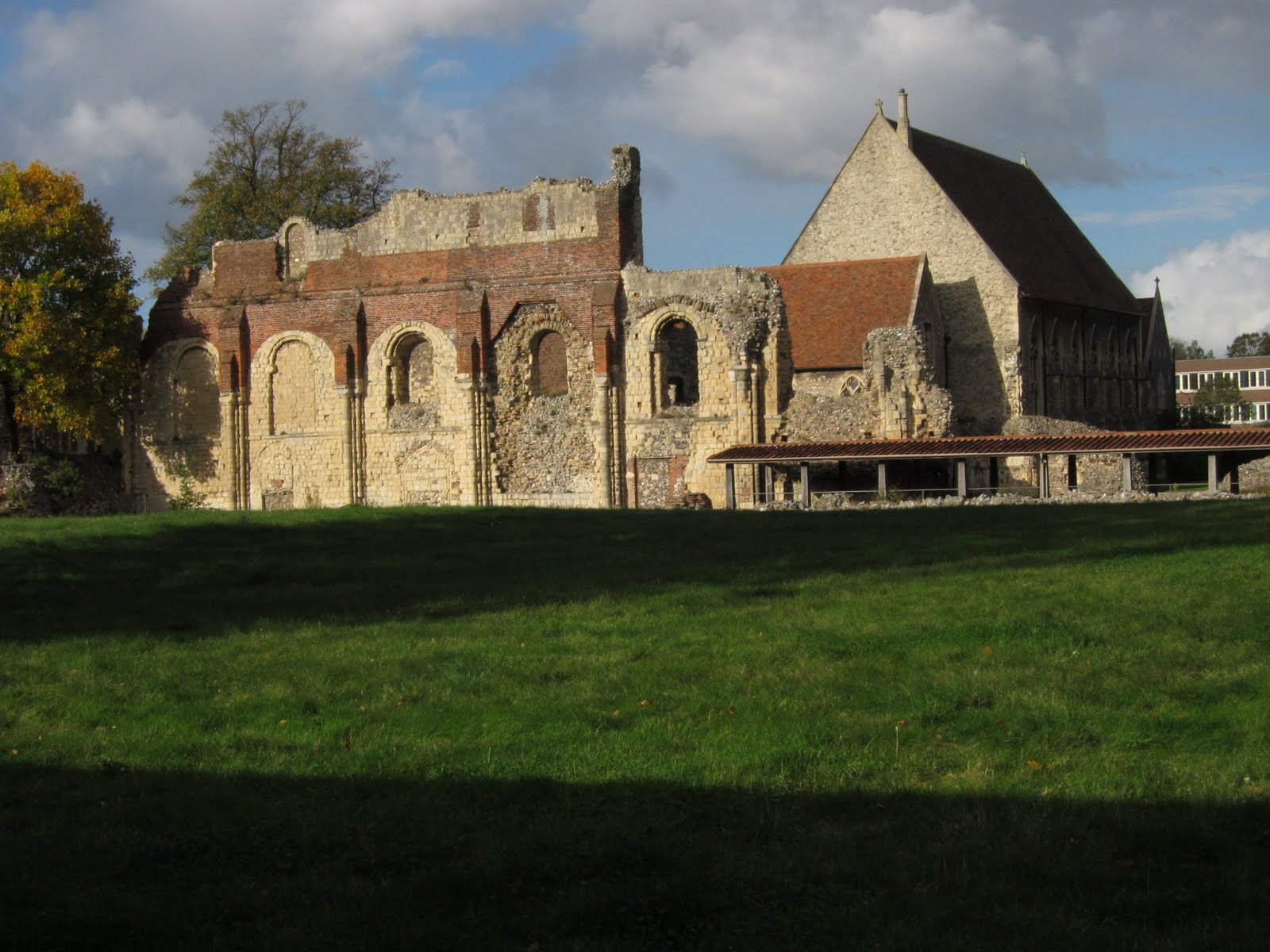
Our family enjoyed this book greatly when we read it as a family read-aloud several years ago, but what truly brought this book to life and history to life, was a day trip to Canterbury last year when our family was in England.  We saw several of the sites that would have been known to St. Augustine, and learned even more about this great saint.

Here is a view inside St. Martin’s Church.  The walls actually pre-date the Christian church, having once been a Roman shrine,  showing how early Christians used the sacred spaces of pagans, “Christianizing” them.  The book Augustine Came to Kent has a moving scene of King Ethelbert’s baptism in this church.

Here is a modern statue of St. Bertha, Ethelbert’s queen, who was herself Christian (and a French transplant to England).  She paved the way for St. Augustine to be welcomed to Kent and bring the Faith to this new land.


Here is a view of the ruins of St. Augustine’s Abbey.


Have you read Augustine Came to Kent?  Do you have any book suggestions about St. Augustine, or just other good summer reading?


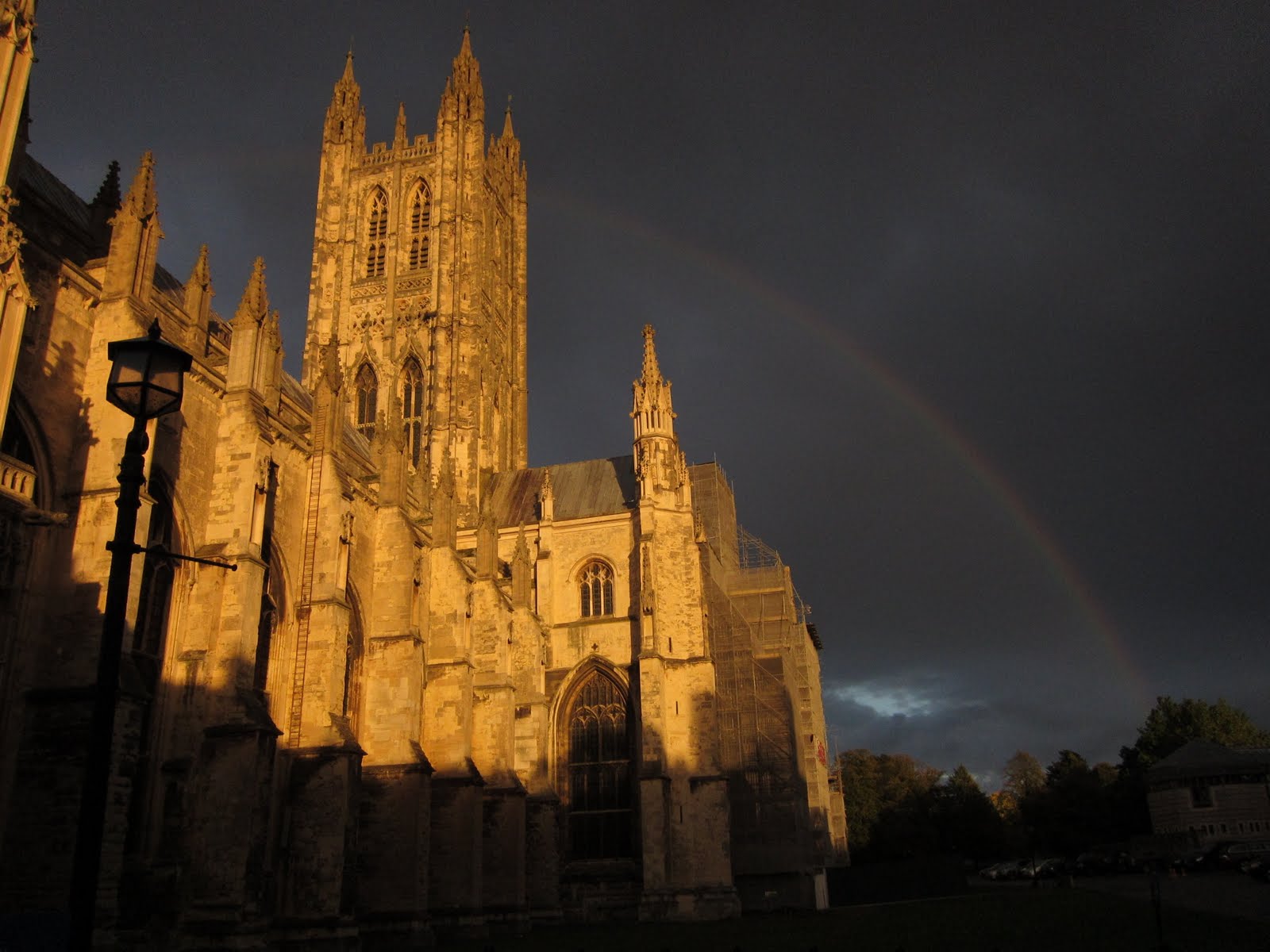
UPDATED:  My husband asked if I had shared a photo of Canterbury Cathedral, and I knew exactly the one he meant.  It was taken on his excellent camera by his excellent eye, as he takes most of the “great photos” in our family.   There was a bit of a rainshower, and afterwards a rainbow:


Share this:

  • Share on Pinterest (Opens in new window) Pinterest
  • Share on X (Opens in new window) X
  • Share on LinkedIn (Opens in new window) LinkedIn
  • Share on Facebook (Opens in new window) Facebook
  • Email a link to a friend (Opens in new window) Email
  • More
  • Share on Reddit (Opens in new window) Reddit
  • Share on Tumblr (Opens in new window) Tumblr

Like this:

Like Loading…
  • « Go to Previous Page
  • Page 1
  • Interim pages omitted …
  • Page 4
  • Page 5
  • Page 6
  • Page 7
  • Page 8
  • Interim pages omitted …
  • Page 28
  • Go to Next Page »

Copyright © 2026 · Atmosphere Pro on Genesis Framework · WordPress · Log in

  • Home
  • About
  • A Literary Pilgrimage
  • Book Group
%d