• Skip to main content

Reading Catholic

Reading Catholic and catholic

  • Home
  • About
  • A Literary Pilgrimage
  • Book Group

Uncategorized

This Lent, Let Mercy Lead

March 2, 2012 by Nancy Piccione

Here is my March column that appears in this weekend’s The Catholic Post.  I invite your feedback here or on Facebook or Twitter.
Do you like reading C.S. Lewis?  Many people, especially converts, do.
I recall first discovering Lewis when I was a young adult and for the first time truly embracing my cradle Catholic faith.   I soaked up his intellectual wisdom,  his sensible, easy-to-read theology and I grew in knowledge of and desire for my faith.  Lewis (like GK Chesterton, whom I find a little harder going) is eminently quotable, with lines that stick with you.
If I could use the analogy for food (and, as longtime readers know, I’m fond of using such analogies), reading C.S. Lewis is a like eating a delicious, multi-course feast, full of a range of dishes that both nourishes and tastes great, and you remember for a long time.
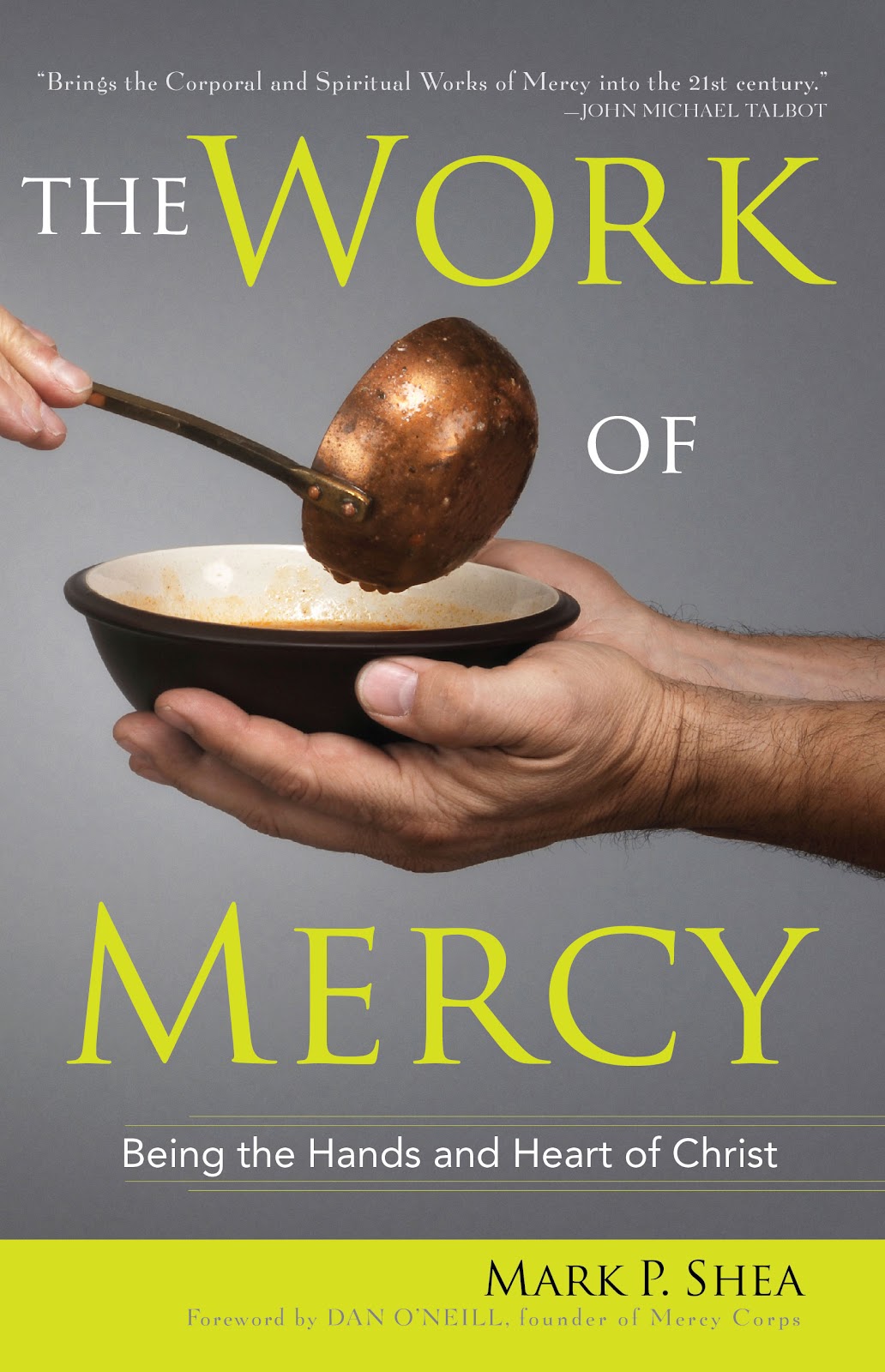
I was trying to find a way to characterize Mark Shea’s writing style as I read his newest book The Work of Mercy:  Being the Hands and Heart of Christ.  What kept occurring to me “he writes like a modern C.S. Lewis.”   Those are some big shoes to fill, but I propose that it’s an appropriate comparison.
I occasionally read Mark Shea’s blog, “Catholic and Enjoying It” http://www.patheos.com/blogs/markshea/author/markshea(and I always smile at the blog’s subhead, “So that no thought of mine, no matter how stupid, should ever go unpublished again!”)
But even though he’s the author of many books, I’ve never read one until The Work of Mercy.Turns out, all these years, I’ve been missing out.
 Mark Shea, like C.S. Lewis, lays out a feast for readers, combining many elements of culture, faith and life in an honest, approachable style.   The Work of Mercy is easy to read, but not “lightweight”; rather, it’s challenging and uplifting in the best way.
The Work of Mercy, with a chapter dedicated to each of the corporal and then spiritual works of mercy, is full of challenges for the individuals, groups and the Church, as well as the world.  It’s such a cliché to say, “I laughed, I cried, I was moved,” but I truly did all these things reading The Work of Mercy.  I had insights and growth in my understanding of works of mercy throughout.  I felt more of a desire to do specific actions to practice specific works of mercy, instead of just reading along and nodding my head (though I did plenty of that, too).
There’s so much varied and good in the book, it’s hard to get too specific, but two elements emerge:
*Shea’s honest humor:  “For me to assume the task of writing about “bearing wrongs patiently” is like asking the Incredible Hulk for anger-management counseling.”
*Shea’s message throughout that the works of mercy not so much change the world as change we who practice them.   In “Visit the Sick,” for instance, Shea writes that, “visiting the sick brings the human dignity of the sufferer into view.”
The Afterword, “What Next?” is especially good—for each of the spiritual or corporal works of mercy, Shea offers varied ideas, as well as web and other addresses for a charity or Christian outreach for action. For instance, for the work of mercy “forgive offenses willingly,” Shea recommends the sacrament of reconciliation, as well as Rachel’s Vineyard and Immaculee’s Rwandan Left to Tell Foundation.
If you’re fasting this Lent from certain foods, consider Mark Shea’s The Work of Mercy a multi-course feast for your spiritual life.

Share this:

  • Share on Pinterest (Opens in new window) Pinterest
  • Share on X (Opens in new window) X
  • Share on LinkedIn (Opens in new window) LinkedIn
  • Share on Facebook (Opens in new window) Facebook
  • Email a link to a friend (Opens in new window) Email
  • More
  • Share on Reddit (Opens in new window) Reddit
  • Share on Tumblr (Opens in new window) Tumblr

Like this:

Like Loading…

The Anti-List for the New Year: Books, Balance & Self-Care

January 1, 2012 by Nancy Piccione

This post is a list of all the books I reference in my talk to the First Saturday group at St. Philomena.  This post describes about the talk and January’s theme–Be Yourself.  Here is where I discuss February’s theme, Pursue Happiness. I’ll do future posts towards the beginning of each month with the  theme, quote and book.   But here is the basic version of all the books & quotes.

January: Be Yourself

An earlier Norton edition was the first P&P I read ( in college).

Pride & Prejudice

Here’s a Kindle version.

“Oh! certainly,” cried his faithful assistant, “no one can be really esteemed accomplished who does not greatly surpass what is usually met with. A woman must have a thorough knowledge of music, singing, drawing, dancing, and the modern languages, to deserve the word; and besides all this, she must possess a certain something in her air and manner of walking, the tone of her voice, her address and expressions, or the word will be but half-deserved.”

“All this she must possess,” added Darcy, “and to all this she must yet add something more substantial, in the improvement of her mind by extensive reading.”

February: Pursue Happiness

Just a few of the happiness books I referenced:

The Happiness Project by Gretchen Rubin
Here’s the five-year sentence-a-day journal.
Sonja Lyubomirsky’s The How of Happiness

Quirky side note about Lyubomirsky’s book: I own the hardback of this, and on the front is a cherry pie.  The paperback version appears to show a lemon meringue pie. Meaning? I know not what, but I find it interesting.

Lucy Maud Montgomery’s Rilla of Ingleside

Quote (from Rilla of Ingleside)

“Now we won’t be sober any more. We’ll look beyond the years—to the time when the war will be over and Jem and Jerry and I will come marching home and we’ll all be happy again.”

“We won’t be—happy—in the same way,” said Rilla.

“No, not in the same way. Nobody whom this war has touched will ever be happy again in quite the same way. But it will be a better happiness, I think, little sister—a happiness we’ve earned. We were very happy before the war, weren’t we? With a home like Ingleside, and a father and mother like ours we couldn’t help being happy. But that happiness was a gift from life and love; it wasn’t really ours—life could take it back at any time. It can never take away the happiness we win for ourselves in the way of duty.”

March: Be a Pray-er and a Prayer

This is the complete boxed set.
Here is a Kindle version of the Lent & Holy Week volume.

Second book of The Mistmantle Chronicles


Quote from Urchin and the Heartstone (The Mistmantle Chronicles, Book 2)

“Alone all day, Juniper would remember the animals and places he loved, and hold them in his own heart before the great Heart that made them. He was learning to find quietness inside himself. He was learning to pray.”

April:  Focus on Finance (through the eyes of faith)

“All The Money in the World is about the link between money and happiness, and how money can be used in our rich society to optimize well-being for ourselves and those we care about. To start, we must stop thinking about money as something evil or soulless,… Instead, we have to start thinking of it as a tool, a means to acquiring, doing and taking care of things that bring us joy. I’ve come to believe that people who are happiest about money operate under three premises of wealth, a word that has less to do with quantity than with outlook:

1. I have enough. There are some people in this world who have more, but also plenty with less.

2. If I want more than I have now to achieve big goals, I can figure out a way to get it.

3. Every dollar is a choice. How I earn it and spend it are up to me.”

May: Start a Garden

(I don’t necessarily mean that literally, as those who know me can attest!).  Just trying to explain/introduce concept of orchids/dandelions as it relates to ourselves and those near us.

Quote from Quiet: The Power of Introverts in a World that Can’t Stop Talking by Susan Cain:

“What scientists haven’t realized until recently is that these risk factors have an upside. In other words, the sensitivities and the strengths are a package deal. High-reactive kids (orchids) who enjoy good parenting, child care, and a stable home environment tend to have fewer emotional problems and more social skills than their lower-reactive peers, studies show. Often they’re exceedingly empathic, caring, and cooperative. They work well with others. They are kind, conscientious, and easily disturbed by cruelty, injustice, and irresponsibility.”

June:  Keep a “sharp eye” on your personality

(here’s a handsome recent paperback, but on Kindle it’s only $1.99 because it’s in the public domain).

Quote from Understood Betsy by Dorothy Canfield Fisher

“The answer to that question is that she didn’t do it because Cousin Ann was Cousin Ann. And there’s more in that than you think! In fact, there is a mystery in it that nobody has ever solved, not even the greatest scientists and philosophers, although, like all scientists and philosophers, they think they have gone a long way toward explaining something they don’t understand by calling it a long name. The long name is “personality,” and what it means nobody knows, but it is perhaps the very most important thing in the world for all that. And yet we know only one or two things about it. We know that anybody’s personality is made up of the sum total of all the actions and thoughts and desires of his life. And we know that though there aren’t any words or any figures in any language to set down that sum total accurately, still it is one of the first things that everybody knows about anybody else. And that is really all we know! 

 So I can’t tell you why Elizabeth Ann did not go back and cry and sob and say she couldn’t and she wouldn’t and she couldn’t, as she would certainly have done at Aunt Harriet’s. You remember that I could not even tell you why it was that, as the little fatherless and motherless girl lay in bed looking at Aunt Abigail’s old face, she should feel so comforted and protected that she must needs break out crying. No, all I can say is that it was because Aunt Abigail was Aunt Abigail. But perhaps it may occur to you that it’s rather a good idea to keep a sharp eye on your “personality,” whatever that is! It might be very handy, you know, to have a personality like Cousin Ann’s which sent Elizabeth Ann’s feet down the path; or perhaps you would prefer one like Aunt Abigail’s. Well, take your choice.”

July: Enjoy leisure and believe wonderful things

Quote from Five Children and It by E. Nesbit

“Grown-up people find it very difficult to believe really wonderful things, unless they have what they call proof. But children will believe almost anything, and grown-ups know this. That is why they tell you that the earth is round like an orange, when you can see perfectly well that it is flat and lumpy; and why they say that the earth goes round the sun, when you can see for yourself any day that the sun gets up in the morning and goes to bed at night like a good sun as it is, and the earth knows its place, and lies as still as a mouse.”

August: Be Brave

(even in private, like Elinor in Sense & Sensibility)

Quote from China’s Bravest Girl: The Legend of Hua Mu Lan

The ocean hides the oyster.
The oyster hides a pearl.
Bright armor and heavy helmet
Hid China’s bravest girl.

September: Seek out kindred spirits, bosom friends

Quote from Anne of Green Gables by Lucy Maud Montgomery:

“Marilla,” she demanded presently, “do you think that I shall ever have a bosom friend in Avonlea?” “A—a what kind of friend?” “A bosom friend—an intimate friend, you know—a really kindred spirit to whom I can confide my inmost soul. I’ve dreamed of meeting her all my life. I never really supposed I would, but so many of my loveliest dreams have come true all at once that perhaps this one will, too. Do you think it’s possible?”

October: Muster your wits 

And what does “muster your wits” mean in your life?  What “guns” do you have to fight sadness?


Quote from Emily of Deep Valley by Maud Hart Lovelace

Depression settled down upon her, and although she tried to brush it away it thickened like a fog. “Why, the kids will be home for Thanksgiving! That will be here in no time. I mustn’t get this way,” she thought. But she felt lonely and deserted and futile. “A mood like this has to be fought. It’s like an enemy with a gun,” she told herself. But she couldn’t seem to find a gun with which to fight.

….

“Muster your wits: stand in your own defense.” She had no idea in what sense he had used it, but it seemed to be a message aimed directly at her. “Muster your wits: stand in your own defense,” she kept repeating to herself on the long walk home. After dinner she sat down in her rocker, looked out at the snow and proceeded to muster her wits. “I’m going to fill my winter and I’m going to fill it with something worth while,” she resolved.

November: Be a Pollyanna

yes, really.  topics: what being a Pollyanna really means; the emotional and spiritual maturity of the “glad game”

Quote from Pollyanna by Eleanor Holmes Porter

What men and women need is encouragement. Their natural resisting powers should be strengthened, not weakened…. Instead of always harping on a man’s faults, tell him of his virtues. Try to pull him out of his rut of bad habits. Hold up to him his better self, his REAL self that can dare and do and win out!… The influence of a beautiful, helpful, hopeful character is contagious, and may revolutionize a whole town…. People radiate what is in their minds and in their hearts. If a man feels kindly and obliging, his neighbors will feel that way, too, before long. But if he scolds and scowls and criticizes—his neighbors will return scowl for scowl, and add interest!… When you look for the bad, expecting it, you will get it.

December: go with your strengths

I wrote a post for Bonnie at A Knotted Life in her Advent series in 2012, and the title there was “Go with Your Strengths.”  For me, that is books.  Here are probably my two favorite  Christmas read-alouds and ones we read every year.

What are your strengths?

The Puppy Who Wanted a Boy

A quote from The Puppy Who Wanted a Boy by Jane Thayer

“I’m not alone,” said the boy. “I’ve got a puppy.”

The Story of Holly & Ivy by Rumer Godden

A quote from Rumer Godden:

“There is an Indian proverb that says that everyone is a house with four rooms, a physical, a mental, an emotional, and a spiritual . Most of us tend to live in one room most of the time but unless we go into every room every day, even if only to keep it aired, we are not a complete person.” 

N.B. This post contains affiliate links.  I’m new to this world, but what it means is that if you click on the link and order a book (or any other item),  I get a small amount of money, though your cost stays the same.

Do you participate in any affiliate programs on your blog or website? I’d be interested to hear your experience/positives, negatives.

Share this:

  • Share on Pinterest (Opens in new window) Pinterest
  • Share on X (Opens in new window) X
  • Share on LinkedIn (Opens in new window) LinkedIn
  • Share on Facebook (Opens in new window) Facebook
  • Email a link to a friend (Opens in new window) Email
  • More
  • Share on Reddit (Opens in new window) Reddit
  • Share on Tumblr (Opens in new window) Tumblr

Like this:

Like Loading…

First, What Are You Reading? Volume 16, Christmas Book Edition, December 2011

December 1, 2011 by Nancy Piccione

Here are my answers to the four questions I ask on the first of each month:
first, what are you reading?
what do you like best about it?
what do you like least?
what’s next on your list to read? 

As always, I hope you’ll consider your current reads on your blog and/or sharing here in the comments or on Facebook.  Happy reading!

Normally, I finish my “first, what are you reading?” post well in advance of the first day of the month, but  this month I did not.  Rather than make it a “second, what are you reading?” post, I’m going to quickly list a couple of Christmas classic books, and invite you to share yours.  No “what I like best, least or next” this time.  You’ll have to fill in for me.  And don’t forget to enter the book giveaway that ends tonight.


First, what are you reading?  


Linda, a fellow library volunteer, shared with me a great book that I read to kids this week in the school library.  It’s called Too Many Tamales by Gary Soto.  It’s a very sweet and funny book, makes you want to make tamales after you finish, and also funny.  A couple of the classes of kids and I worked out the math problems if four kids had to eat the 24 tamales, how many tamales each?  Thanks for introducing it to me, Linda!

We haven’t gotten out any of our Christmas books yet, but two of our absolute favorites are The Puppy Who Wanted a Boy by Jane Thayer (note that we have that actual older edition, given to me several years back by one of my sisters).  It’s fairly goofy, but I pretty much have it memorized after reading it four Christmases ago literally every day from about December 15 to mid-February, so fond was our then four-year-old of that book.  We all still love it.

The other every Christmas must read aloud, though my kids are getting older, is Rumer Godden’s The Story of Holly & Ivy”


.  I see a handsome new edition came out last Christmas, and I might have to invest in that this year.  We have a very old edition of this.

What are the favorite perennial Christmas books at your house?

Share this:

  • Share on Pinterest (Opens in new window) Pinterest
  • Share on X (Opens in new window) X
  • Share on LinkedIn (Opens in new window) LinkedIn
  • Share on Facebook (Opens in new window) Facebook
  • Email a link to a friend (Opens in new window) Email
  • More
  • Share on Reddit (Opens in new window) Reddit
  • Share on Tumblr (Opens in new window) Tumblr

Like this:

Like Loading…

Not Far From the Kingdom of God: UPDATED

October 7, 2011 by Nancy Piccione

best cartoon I've seen Remember Steve Jobs. #thankyouste... on Twitpic

Thomas Peters’ cartoon of Steve Jobs at the Pearly Gates, going viral on Twitter today, really sums up my feelings today about Steve Jobs–that he in reality is not far from the Kingdom of God.  ( For some reason the “TwitPic” link is not working well, or at least it doesn’t look like very good resolution as I write this in draft form–you can visit this link to see this simple but practically perfect cartoon in much better resolution.)

I am uber-geeky about the death of Steve Jobs, and basically warrant some of the criticism people are having of the outsize reactions to Jobs’ death.  Last night, I subscribed to the Twitter hashtag #apple so I could show our family all the tweets streaming in for Jobs.  I laughed loudly when a Facebook friend, fond of putting up photos of the wrong celebrity when one dies (Liam Neeson instead of Leslie Nielson, for example), put a photo of Bill Gates up with the caption, “Steve Jobs, you will be missed.”

And this morning, I actually, truly, tweeted and put on Facebook, “At Mass this am, saw 2 others wearing jeans & black, but I was too shy to ask if they were, like me, geeky & doing it for Steve Jobs.”

From what I can discover, Steve Jobs professed no faith, but he is one of several famous people I consider “not far from the Kingdom of God” because of their desire for truth, beauty, and goodness.  Another example is Clint Eastwood–he says he does not believe in God, but how can a person make the movies “Gran Torino” or “Invictus” without some kind of yearning and desire for the Good?

Steve Jobs or Clint Eastwood remind me of the Calormen soldier Emeth in C.S. Lewis’ The Last Battle, last book in the Chronicles of Narnia series.  For those who have not read it, Emeth arrives in Aslan’s country to Aslan’s welcome, but Emeth protests that he has always followed and sought Tash, the demonic “god” of the Calormens.  How could Aslan accept him as a son?  Aslan replies, “Beloved, .. unless thy desire had been for me thou wouldst not have sought so long and so truly.  For all find what they truly seek.”

There are tons of Web reflections and tributes to Steve Jobs today. I especially enjoyed Jeff Geerling’s tribute: “Steve“, in which Geerling reminds us of Jobs’ opposition to porn on the App store, and many of his other terrific qualities.   His love of beauty and a clean design for Apple products, even the parts customers would not generally see, shows there was something in him that sought and delighted in goodness. The Anchoress also had a great reflection and roundup of various reactions around the Web.  And Marc Cardaronella, a local friend we know in real life (I featured his wife Shannon as a “Meet a Reader” early this year), shares Steve Jobs “life lessons for Catholic leaders.”

A friend on Facebook responded to my “wearing jeans and black at Mass” status that today’s Gospel, from Luke 11, was great, and in re-reading it, I thought about Jobs and his relentless searching and knocking, and how the Lord promises that the door is always opened.  May it be so, and may Jobs’ soul, through the mercy of God, rest in peace:

‘So I say to you: Ask, and it will be given to you; search, and you will find; knock, and the door will be opened to you. For the one who asks always receives; the one who searches always finds; the one who knocks will always have the door opened to him. What father among you would hand his son a stone when he asked for bread? Or hand him a snake instead of a fish? Or hand him a scorpion if he asked for an egg? If you then, who are evil, know how to give your children what is good, how much more will the heavenly Father give the Holy Spirit to those who ask him!’


UPDATE:  I don’t know how I missed several points in my original post.  One, that I (and our whole family) has multiple, multiple Apple products.  I am not going to even count them because I fear it would be embarrassing.  And I have never gotten rid of one.

For instance, when a nephew told me Apple offers a 10 percent discount at the Apple store if you bring in an old iPod or other device, I brought the first iPod (now nonworking even after my cardboard fixes) my husband got me years ago, to an Apple store in the plans of getting a discount, and I accidentally on purpose forgot to turn it in.

That reminds me that it is my husband who loves and points out to me all the new Apple products and how beautiful they are.  So I am in gratitude to him for getting us started on the Apple path, because Apple products have saved me so much time and angst from my Windows days, I can’t even begin to add them up.

Finally, how did I neglect, when I was retweeting the fact profusely, about the fact that Steve Jobs was adopted, and what his unplanned conception might have meant in the post-Roe world?

Share this:

  • Share on Pinterest (Opens in new window) Pinterest
  • Share on X (Opens in new window) X
  • Share on LinkedIn (Opens in new window) LinkedIn
  • Share on Facebook (Opens in new window) Facebook
  • Email a link to a friend (Opens in new window) Email
  • More
  • Share on Reddit (Opens in new window) Reddit
  • Share on Tumblr (Opens in new window) Tumblr

Like this:

Like Loading…

QR Codes as a Tool for Catholic Evangelism

September 15, 2011 by Nancy Piccione

I’ve been seeing QR codes everywhere, and after reading about it this past summer in a David Pogue column explaining new technology trends.  QR codes are, as Pogue writes:

:those weird, square, pixelated black-and-white bar codes that are cropping up on billboards, movie posters, signs, magazine ads and business cards. Nobody ever bothered to explain them. (They’re QR codes — quick response bar codes. You can scan them with your iPhone’s or Android phone’s camera, using a special app that translates it into an ad or takes you to a related Web page.)

So earlier this summer, I downloaded an App that “reads” them, and our family has been finding them everywhere.  We were at the grocery store at the beach, and there was a QR code on the box of watermelon.  One of the kids scanned it and it had a mobile-ready recipes, information.  It was cute!

One of the things we all noticed about the QR codes is usually how useless they are–they bring you to a web page that might not even be mobile-ready, so you can’t even read it, or just not that helpful.   Many marketing pros and others have written about this on the web, and even highlighted the many unhelpful or just plain bad QR code “landing pages.”

As we kept discovering them, the good, the bad and the ugly QR codes, depending on where the code “landed” you, I thought, why couldn’t this be an opportunity to invite people to prayer?  Or find a way to spread the word about something Catholic?

So I proposed to my editor that we put a QR code in the Catholic Post.

Fortunately, he’s always up for trying out new ideas.

It would be related to my September column featuring 9/11 books, but “land” people who scanned the QR code at a page with the prayer of Father Mychal Judge.

The blog is mobile-ready, so the prayer is easy to read on a phone or other mobile device.  I actually back-dated the post/prayer to September 11 last year, since my column reaches some people before my column posts on the blog.

Here is the QR code I generated using one of the many free sites that offer QR codemaking:

My thinking was that a person who might not read the Post normally might see the QR code (at their parents’ or grandparents’ house, perhaps?), and, if they were familiar with using them, still scan the code for fun, as we have done so much in our family in recent months.  And then perhaps that unnamed person would pray the prayer, or at least be inspired to read more of the Post and learn more about the Faith.

Before the Post QR code printed, our local parish bulletin featured a QR code, a pretty cool one with the “Word on Fire” logo in the middle, which landed my iPhone at the promo video for Father Robert Barron’s Catholicism series.  I was so glad to see this great use of a QR code, better than pretty much any of the ones to promote a product that I have seen.

I am hoping to do this again in the future, perhaps along with my October column on books about Teresas, landing at a prayer by St. Therese or Blessed Teresa of Calcutta.   Any suggestions on a good prayer for that?

What do you think about QR codes?  Do you use them?   Do you think they have the potential to be a tool for evangelism?

Share this:

  • Share on Pinterest (Opens in new window) Pinterest
  • Share on X (Opens in new window) X
  • Share on LinkedIn (Opens in new window) LinkedIn
  • Share on Facebook (Opens in new window) Facebook
  • Email a link to a friend (Opens in new window) Email
  • More
  • Share on Reddit (Opens in new window) Reddit
  • Share on Tumblr (Opens in new window) Tumblr

Like this:

Like Loading…

Helping Children Make Sense of 9/11, 10 Years Later

September 8, 2011 by Nancy Piccione

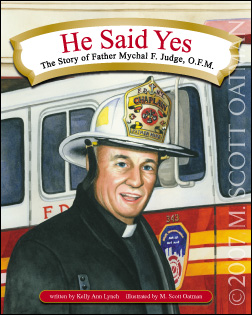
The primary book that I reviewed this month was a children’s book about the events of 9/11, He Said Yes:  The Story of Father Mychal Judge, by author Kelly Ann Lynch.   It wasn’t entirely intentional to focus on a children’s book, but as I argue, sometimes “just a kid’s book” can be more insightful and meaningful than books for adults.

Earlier today, I listened to a radio interview with a American studies professor discussing the “art of 9/11,” focusing exclusively on novels, movies and songs for adults that have come out of the tragedy, and their meaning, and how they have helped us heal (or not) after 9/11.  It was a fascinating interview; yet I found myself thinking about how much more do children need help in processing and understanding difficult events like what happened on 9/11.
I am a volunteer in the library of our children’s grade school, and I’m fortunate to get the chance to read to the students.  Earlier this week, I read through He Said Yes with different grades of kids, and we talked about what happened that day.  This book ended up being a great way for kids who were unaware of 9/11 to learn about it gently, as 9/11 images are all over the news, and the students are bound to be confronted with it.  Learning about the heroism of Father Judge and others will give, I hope, some framework for understanding beyond the images.
Some of the kids asked me, “Is that a true story?” so we talked about how Father Judge is the listed as the first official fatality on that day.  I was surprised that every single time I read it, I choked up on the last pages of the book, when author Lynch quotes John 15:13, “When Father Mychal ran to the towers, he was following in the footsteps of Jesus, who told his disciples, “No one has grater love than this, to lay down one’s life for one’s friends.”

Here are several other children’s books to help children to learn about and understand 9/11 as we remember 10 years later:
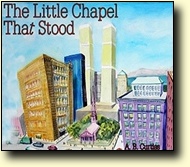
The Little Chapel That Stood by A.B. Curtis is a beautifully illustrated and lyrical poem-book about Old St. Paul’s Church, which survived the attacks at Ground Zero, and became a place of refuge for firefighters and others.
If you can, reading an actual copy of The Little Chapel That Stood makes for great reading with small children; the book itself is handsome and a nice size.  Unfortunately, it looks like it is difficult to order quickly; for instance, I see Amazon lists it as a one- to three-month delivery time.  Fortunately, I discovered an online version of the story on the author’s website.  Do read it, and be prepared to choke up a little if you do read it out loud, when you read many lines, especially about how the firefighters hung up their shoes on the fence of the church: “Oh what gallant men we did lose, who never came back to get their shoes!”
[The interesting Catholic trivia connection to Old St. Paul’s, an Episcopal Church, is that St. Elizabeth Ann Seton, the first American-born canonized saint, was married to her husband, William Seton, in St. Paul’s, on January 25, 1774.]
Also, blog commenter Marie jogged my memory about The Little Chapel That Stood, that I hadn’t picked up in years. Thanks, Marie!
Fireboat:  The Heroic Adventures of the John J. Harvey by Maira Kalman, is another great book about the great and small heroism around 9/11.  This book, too, shows how ordinary people worked to stop the fires at the Twin Towers with a previously retired and restored 1930s-era fireboat.  The illustrations are a kind of modern folk-art, and the text is delightful in conveying such difficult themes.
Do you know of any other 9/11 books for children?  How are you discussing 9/11 with your children?

Share this:

  • Share on Pinterest (Opens in new window) Pinterest
  • Share on X (Opens in new window) X
  • Share on LinkedIn (Opens in new window) LinkedIn
  • Share on Facebook (Opens in new window) Facebook
  • Email a link to a friend (Opens in new window) Email
  • More
  • Share on Reddit (Opens in new window) Reddit
  • Share on Tumblr (Opens in new window) Tumblr

Like this:

Like Loading…
  • « Go to Previous Page
  • Page 1
  • Interim pages omitted …
  • Page 3
  • Page 4
  • Page 5
  • Page 6
  • Page 7
  • Interim pages omitted …
  • Page 28
  • Go to Next Page »

Copyright © 2026 · Atmosphere Pro on Genesis Framework · WordPress · Log in

  • Home
  • About
  • A Literary Pilgrimage
  • Book Group
%d