• Skip to main content

Reading Catholic

Reading Catholic and catholic

  • Home
  • About
  • A Literary Pilgrimage
  • Book Group

Uncategorized

After the Revolution, Rotten Fruit, Discouragement–And Hope

July 6, 2012 by Nancy Piccione

During my college years in the 1980s, I was a (nominal) cradle Catholic, and fairly immersed in the college culture of the time.  I was especially drawn to various trendy, or what we called back in the day “politically correct,” ideas and philosophies.

Exhibit A: I thought Gloria Steinem, who spoke at our campus, was glamorous and made terrific sense.
All joking about Gloria Steinem aside, by far the most memorable speaker was a beautiful young woman, a former porn film worker, who gave a speech  (from a feminist perspective) on the evils of pornography.
It gave me–to this day–an implacable hatred of porn as something bad for women and corrosive to society.
I’m incredibly grateful for that speaker, who opened my eyes at such an early age of the high cost of “anything goes.”  But it was awful to sit through and to hear.

Mary Eberstadt’s Adam and Eve After the Pill: Paradoxes of the Sexual Revolution reminds me of hearing that speech.  This book is not enjoyable –in fact, reading it can be downright discouraging.  But it is a must-read in understanding, “the moral core of the sexual revolution (is) the abundant evidence that its fruits have been rottenest for women and children.”

Every single essay-chapter is important and stands alone.  It’s hard to pick out a best chapter, but “The Will to Disbelieve” is crucial in setting up the notion that society at large is largely ignoring the clear results of the sexual revolution, much the same way the “the moral facts about the Cord War remained disputed at the highest intellectual levels, especially on American campuses, until about two seconds before the Berlin Wall came down.”
Perhaps the only hopeful chapter of Adam and Eve After the Pill is “‘Pedophia Chic’ Then and Now” which outlines how just a few short decades ago, pedophilia was more in vogue and even defended in the public square such as mainstream magazine articles.  Ebertstadt writes that it is “a small case of small but real moral progress that bodes a little better for the youngest and most innocent among us, even as it confirms that the sexual revolution has made the world a more dangerous place for them.”
Hope may be hard to come by when reading Adam and Eve After the Pill, but hope and peace suffuse My Peace I Give You: Healing Sexual Wounds with the Help of the Saints by Catholic convert Dawn Eden.

In many ways, My Peace I Give You is a personal testimonial to the rotten fruits documented in Adam and Eve After the Pill.  As a child of divorce, Eden experienced sexual abuse in various settings, then as a young adult lived promiscuously to “take control” of her sexuality.  But wholeness and true happiness remained elusive.

In Eden’s 2006 international bestseller, The Thrill of the Chaste, Eden wrote about discovering the appeal that modesty and sexual restraint offer, but had not yet come to terms with the legacy of abuse in her life.
During and after her conversion to Catholicism, Eden sees that healing from those sexual wounds is ongoing and a work of the Holy Spirit, through specific saints who provide solace on the journey.
As she writes to the many who are childhood sexual abuse victim, “I want you to know you are not alone, you are not forgotten, and you have more friends in heaven than you realize.”
My Peace I Give Youis part memoir and part meditations on what the saints can teach us about wholeness of body, mind and spirit, even in the face of searing memories and experiences.
Some of the saints in My Peace I Give You are victims of sexual abuse; some are not; but in Eden’s heartfelt and careful reflection, all have something to offer those who have undergone abuse, or those whose hearts breaks for them.
This column appears on the book page of the print Catholic Post this weekend.  It’s an interesting, I would venture to say providential, “coincidence,” that this review appears here on the feast day of St. Maria Goretti.  Eden in particular has an insightful chapter in her book My Peace I Give You on this much-known but little-understood saint. 

Share this:

  • Share on Pinterest (Opens in new window) Pinterest
  • Share on X (Opens in new window) X
  • Share on LinkedIn (Opens in new window) LinkedIn
  • Share on Facebook (Opens in new window) Facebook
  • Email a link to a friend (Opens in new window) Email
  • More
  • Share on Reddit (Opens in new window) Reddit
  • Share on Tumblr (Opens in new window) Tumblr

Like this:

Like Loading…

First, What Are You Reading? Volume 23, July 2012

July 1, 2012 by Nancy Piccione

Updated:  I’ve added back in the link I made many moons ago, but haven’t used in also many moons, since Bonnie was gracious enough to write her own here on her blog, Learning to be a Newlywed.

Here are my answers to the four questions I ask on the first of each month:
first, what are you reading?
what do you like best about it?
what do you like least?
what’s next on your list to read?

As always, I hope you’ll consider your current reads on your blog and/or sharing here in the comments or on Facebook.  Happy reading!

First, what are you reading?  

All the Money in the World: What the Happiest People Know About Getting and Spending by Laura Vanderkam.

Pride & Prejudice by Jane Austen.

What do you like best about them? 

Vanderkam is a kindred spirit; she’s one of those writers I read (surprisingly rare) who I wish I could go out for coffee with and just gab.  She seems like an interesting person who would make a good friend.  I really enjoy her writing style and her general take on things.

Last year, I read Vanderkam’s first book 168 Hours: You Have More Time Than You Think and reviewed it in a prior “first, what are you reading?”    I liked that book pretty well, but I really  enjoyed All the Money in the World.

All the Money in the World explores the ways people spend money and how we can be more intentional about spending, saving and giving.  Every chapter offers very specific ideas and conversation starters.  Like 168 Hours, Vanderkam offers outside-the -box ideas for tackling the specifics.  For instance, she recommends people think of how life would change if you had all the money in the world, or at least all the money you needed.  Would you quit your job? Travel more? Give more to charity?  Then she challenges readers to do just that.

Vanderkam has a great chapter on dreaming big when it comes to charitable giving.  I hate when books about finance don’t stress this.  She points out that being intentional and thinking creatively about giving to charity can be great for both the charity and one’s own happiness.

This marks the umpteenth time that I have read Pride & Prejudice.    It may seem wrong for me, who has so much new to read, to revisit this book, but it makes me happy, so there.

The ostensible reason for reading P&P again is that last month, my daughters and I saw an excellent theater production of “Pride & Prejudice” at the Lifeline Theater in Chicago. I wrote about that here. It was a terrific production, and I highly recommend if you live in the area and love Jane Austen, you consider going to it.  We loved it!  It’s been extended until July 8, with good reason.  I wrote more about that here in my “literary pilgrimage.”

So after we saw it, I was determined to again re-read the novel and see how “lesser” lines from the play compare.  The play was remarkably true to the book, except in the play at several points, the character Elizabeth Bennet talked directly to the audience.   It was utterly charming and funny, and I loved that touch about the play.

What do you like least about them?

Really, I liked just a bout everything about All the Money in the World, except I wish I had more time to discuss it in our family and talk over financial literacy, and in particular passing that on to our children.

Last month, I wrote about how I found Michael Hyatt’s Platform helpful, but not as applicable to a busy mom.  I find both of Vanderkam’s books really helpful right now in my life, with a mix of work and family.

What’s next on your list to read?

I wish I could start reading Sense & Sensibility to keep reading Jane Austen, but I really need to branch out next month.

I’ve started to read The Hobbit by J.R.R. Tolkien with our 9-year-old.  We are having a great time, and I hope to work through the entire Lord of the Rings trilogy after finishing The Hobbit.  I’m not sure if anyone in our family will be going to see the forthcoming Hobbit movie this winter, but at least we will have read the book ahead of time if we decide to see it.

So, what are you reading these days?  Any books you would like to share?

Share this:

  • Share on Pinterest (Opens in new window) Pinterest
  • Share on X (Opens in new window) X
  • Share on LinkedIn (Opens in new window) LinkedIn
  • Share on Facebook (Opens in new window) Facebook
  • Email a link to a friend (Opens in new window) Email
  • More
  • Share on Reddit (Opens in new window) Reddit
  • Share on Tumblr (Opens in new window) Tumblr

Like this:

Like Loading…

Maurice Sendak, RIP: UPDATED

May 8, 2012 by Nancy Piccione

Rest in peace, Maurice Sendak.

Our family has a long association with Maurice Sendak, children’s book author and illustrator.  In my childhood, I (or at least our house) had a copy of Where the Wild Things Are.  I especially loved Max’s room and how his supper was warm in it.  We weren’t ever allowed to eat in our bedrooms.  To the young me, it seemed fantastic and wonderful that Max could have supper in his room, especially after such misbehavior and such an adventure (even in his dreams).

When my husband and I were first married and he had convinced me that a puppy was a good idea, the first book we read together about it was The Art of Raising Your Puppy by the Monks of New Skete, an order of Orthodox brothers who train dogs as their charism.  For some reason, it was comforting that Maurice Sendak had his dogs trained personally with the Monks, as they discuss in the books.

And when children came to our house, Where the Wild Things Are was a perennial favorite at bedtime.  In particular, after a bad day, it was one of the very reliable soothing books, along with Goodnight Moon and really anything by Margaret Wise Brown.   Knowing that your supper would be waiting for you after adventures, that mom and dad will love you no matter how “wild” you are.  It’s just a perfect book.  With every one of our children, whenever I got to the line, “and Max wanted to be where someone loved him best of all…”  each one of our children would blurt out, “with his mommy and his daddy” as if it were in actually written in the text, and so for that book, for us, it is.

When I kept a personal blog many years ago, I had pseudonyms for my children, and our son’s name was “Max.”  Now you know why.

Somewhere, many years ago, I read that Where The Wild Things Are is like a kids’ version of the Parable of the Prodigal Son.  Read it again with that in mind, and I think you will agree.

We have never seen the movie that was made several years back.  None of us really wanted to, even though the promotions were quite appealing.  I just don’t know how you can improve upon or make a full-length movie about a perfect picture book.  It’s like making a movie about The Runaway Bunny.  How can it possibly be any good?

Maurice Sendak illustrated, but did not write, the Little Bear books (writing was by Else Holmelund Minarik) , and I saw an interview with Sendak once in which he mentioned how important it was for him to get the mother illustrated just so.  The illustrations are what “make” the Little Bear series, and noticed how the picture that Little Bear drew in the story, A Kiss for Little Bear is a primitive Wild-Thing like monster.  The Little Bear books were so popular young-age books at our house.  Our oldest had “Birthday Soup” memorized at 3 years old–there’s a video of that somewhere (oh, what did we people do who had kids before YouTube?).  We also know large parts of most of the rest of the Little Bear books.  I have especially fond memories of illustrations in The Goblin Story and Little Bear is Not Sleepy and oh, just about all the others.  So I’m going to stop now.

Sendak had a book come out in the last year, but it was not well-reviewed.  I didn’t like all of Sendak’s work, so it wouldn’t surprise me if this one isn’t great.  Where the Wild Things Are and Little Bear are enough to make him well-loved at our house.

UPDATE:

Earlier today, I was driving into town to meet my husband for noon Mass, and I listened to a part of the NPR show “Fresh Air” where today, the show replayed several previous interviews host Terry Gross did with Sendak in recent years.  [As a total aside, can I say that she is an AMAZING interviewer when not constrained by the age of celebrity and uber-scripted interviews, which sadly is most of the time these days].

She asked Sendak at one point about his lack of faith (Sendak had been raised Jewish), and mentioned she thought his unbelief seemed to grow stronger instead of being tested.  He said something along the lines of (I’m paraphrasing here) “oh, yes, absolutely, I don’t think there is anything after death, which is why it’s so sad when my friends die.”   And yet he said he did not fear death, and did not mind getting old as it allowed him time to read books and listen to great music. But then he said,  a choke in his voice, “I believe I will see my brother again.”

From the “Fresh Air” page with the entire interview, well worth a listen:

“I have nothing now but praise for my life. I’m not unhappy. I cry a lot because I miss people. They die and I can’t stop them. They leave me and I love them more. … What I dread is the isolation. … There are so many beautiful things in the world which I will have to leave when I die, but I’m ready, I’m ready, I’m ready.”

After listening to this, and hearing his search for the good and beautiful, I can only to pray for him in the fond hope that he is re-united with his brother, where are all re-united perfectly.  I need to start a category in labels of “not far from the Kingdom of God,” for which I consider Maurice Sendak in that category, along with Steve Jobs.   All these Emeths (from C.S. Lewis’ The Last Battle who “all find what they truly seek.”

Share this:

  • Share on Pinterest (Opens in new window) Pinterest
  • Share on X (Opens in new window) X
  • Share on LinkedIn (Opens in new window) LinkedIn
  • Share on Facebook (Opens in new window) Facebook
  • Email a link to a friend (Opens in new window) Email
  • More
  • Share on Reddit (Opens in new window) Reddit
  • Share on Tumblr (Opens in new window) Tumblr

Like this:

Like Loading…

Word on Fire

April 15, 2012 by Nancy Piccione

Following is my April column that appears in this weekend’s The Catholic Post.  I loved the idea of a Bible that makes lectio divina practically effortless, and I also point readers to a great book for an introduction and “why you should” consider lectio.  I invite your feedback here or on Facebook or Twitter.
Here’s the problem for a book reviewer:  how do you review the Bible?
Potential review: I laughed, I cried, I was moved.
Pros: I love the author.
Cons: it’s really, really long.
Cue The Catholic Prayer Bible: Lectio Divina Edition, published by Paulist Press and edited by Lawrence Boadt, CSP.  This well-designed Bible makes lectio divina—“divine reading”–doable for the average Catholic.
So I confess that this isn’t really a review of the Bible as text, but rather showing how this edition of the Bible is built on the ancient Christian practice of lectio divina, a prayerful way to read (lectio) the Divine Word of God.
I’ve seen lectio divina broken into various numbers of steps, from four to seven, but Fr. Boadt provides four:  Read, Reflect, Pray and Act.
Fr. Boadt recommends sticking with an entire book of Scripture and not just jumping around, but I’m grateful to see that he’s not recommending that one read the Bible start to finish.  I tried that way back in my 20s when a Protestant friend gave me a schedule for reading the Bible in one year.  I got somewhere into Numbers before I gave up, an utter failure.
I hope that increased maturity, and the accountability of having to write about it here and on the blog, will help me to be better about making Scripture reading & prayer part of my day. But it’s The Catholic Prayer Bible itself that makes it much more achievable.
The Catholic Prayer Bible is simply laid out.  The Scripture itself takes up two-thirds of the page, with a small box of lectio divina reflections for each of the four steps (Read, Reflect, Pray, Act) in a small dark red box on the remaining third.  There are short prompts for each of the steps.  For instance, in John 13:1-30, where Jesus washes his disciples’ feet, the “Act” step is: Perform some humble service for another, especially someone who is dear to you.”
I love how The Catholic Prayer Bible makes it painless and even easy to jump in, right now, to incorporate lectio divinainto a busy life.
The Scripture readings are short, bite-sized portions, no more than several dozen verses.   It’s not an overwhelming amount of text to “get through” through before praying and reflecting.
The Catholic Prayer Bible helps slow fast readers down.   I’m a fast reader in general; that’s helpful as a book reviewer.  But when reading Scripture, I find it difficult to just slooow down and savor.  Having just a few verses to read, reflect, pray and act on makes that “slowing down” much easier.
The “Act” prompts, in particular, helps the reader come away with a specific resolution to bring into everyday-ness.  Even when I found the “Act” suggestion unhelpful or not relevant, it prompted me to make a resolution of my own to bring Scripture into my life.
If you want more of the “how-to” and why of lectio divina, as well as a beautiful, easy-to-read history and reflection, consider the recent Praying Scripture for a Change: An Introduction to Lectio Divina. The book is by Dr. Tim Gray, best known for partnering with Jeff Cavins in developing The Great Adventure Bible Study series.
Gray says, “If you have trouble praying, then welcome to the human race.”  Praying Scripture for a Change offers reasons and practical tips of how lectio divina can work to help us get over our natural inclinations not to jump into prayer.  This book inspired me to consider deeply why it’s important to let God speak to me through Scripture.
Reading Praying for a Change will give you the desire to incorporate lectio divina into your prayer life.  Using The Catholic Prayer Bible will make it easy for you to start.  Then, prepare to reap the real spiritual and temporal benefits of this ancient practice.

Share this:

  • Share on Pinterest (Opens in new window) Pinterest
  • Share on X (Opens in new window) X
  • Share on LinkedIn (Opens in new window) LinkedIn
  • Share on Facebook (Opens in new window) Facebook
  • Email a link to a friend (Opens in new window) Email
  • More
  • Share on Reddit (Opens in new window) Reddit
  • Share on Tumblr (Opens in new window) Tumblr

Like this:

Like Loading…

Meet a Reader: Emily Stimpson

March 5, 2012 by Nancy Piccione

This month’s “reader” is an author with local roots.  My review of her new book is in the current print Catholic Post  Thanks, Emily!  I look forward to meeting you at the Behold Conference in just a few days.


How you know me: I’m a contributing editor to “Our Sunday Visitor,” a blogger for CatholicVote, and the author of The Catholic Girl’s Survival Guide for the Single Years. Although I now live just outside of Pittsburgh (in Steubenville, Ohio), I was born and raised in Rock Island, attended Jordan Catholic School, and go to Mass at St. Mary’s Parish when I’m home visiting my parents, Gary and Ricki Stimpson. Most of my family still lives in the Peoria diocese, including my second cousin Adam, who is parochial vicar for three parishes in LaSalle, and my aunt Susie Budde, who directs choirs for both Sacred Heart Rock Island and Sacred Heart Moline.
Why I love reading: Story-telling, at its best, is truth-telling. A good story gives flesh to all that’s beautiful and true. That helps us discover worlds and ideas beyond our imagining. It also helps us discover much more familiar territory: the human heart.
What I’m reading now:  It’s Lent, so I’ve had to lay aside the Agatha Christie murder mystery I was reading and pick up my normal Lenten fare, Dante’s Divine Comedy. Every Lent my goal is to make it all the way from the beginning of Dante and Virgil’s tour through Hell in the Infernoto Dante’s reunion with his lost love Beatrice in the Paradiso. That literary journey helps me understand the journey every soul is on in this life. It also reminds me why we Catholics do what we do during Lent—what all that praying, fasting, and sacrificing is about.
My favorite book: I love too many books to pick just one, so I always tell people I have favorite authors more than favorite books, writers who’ve changed the way I see the world and the life I’m living. At the top of that list are C.S. Lewis, G.K. Chesterton, and John Paul II: Lewis for his clarity, Chesterton for his sense of wonder, and John Paul II for his theology of the body, which is really an articulation of the Incarnation and what it means to be a human person. If I had to add one more, it would be P.G. Wodehouse: He’s a master of wit and words. A regular dose of his work keeps my writing sharp, quick, and tight.

Share this:

  • Share on Pinterest (Opens in new window) Pinterest
  • Share on X (Opens in new window) X
  • Share on LinkedIn (Opens in new window) LinkedIn
  • Share on Facebook (Opens in new window) Facebook
  • Email a link to a friend (Opens in new window) Email
  • More
  • Share on Reddit (Opens in new window) Reddit
  • Share on Tumblr (Opens in new window) Tumblr

Like this:

Like Loading…

A Catholic Girl’s Survival Guide for the Single Years

March 4, 2012 by Nancy Piccione

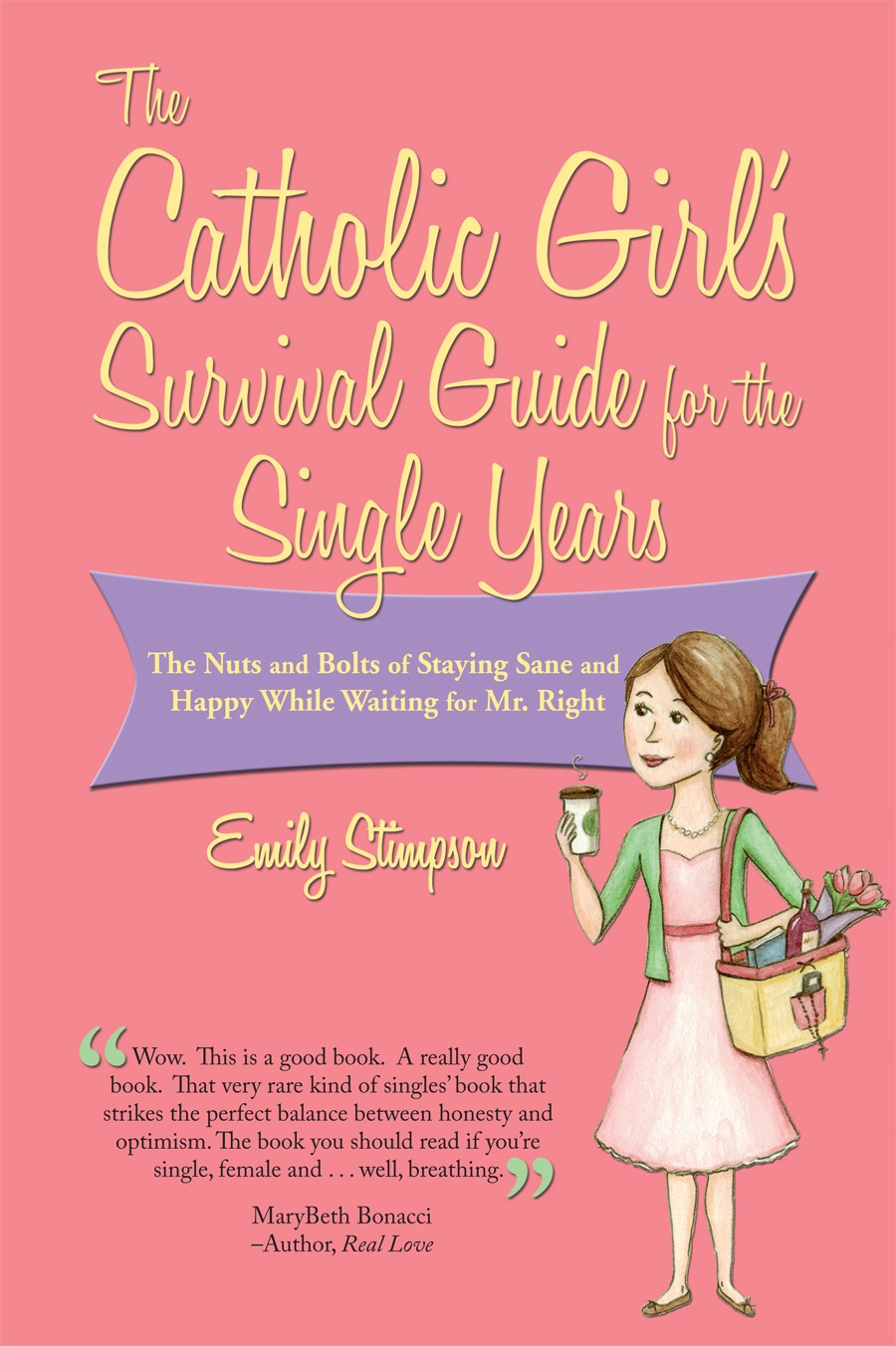
If you get the print edition of The Catholic Post, you’ll notice the book page’s “Meet a Reader” feature this month is a writer with local roots (updated the link)—Emily Stimpson, author of The Catholic Girl’s Survival Guide for the Single Years.

Stimpson’s book is a must-read for young Catholic women.  There’s sensible advice about everything from dating to careers to married friends, and so much more, all from an optimistic and realistic Catholic perspective.   I have so many books I want to (and frankly, “have to”) read, but I enjoyed every chapter of this engaging book because of Stimpson’s spirited and honest voice.  I even breezed through  (and found interesting!) the closing “bibliographic essay” with a wealth of resources for further reading and discussion.

If you’re married already, reading A Catholic Girls’ Survival Guide makes you say, “I wish there had been a book like this when I was single!” At least, it was my first thought– I know I’m not the only one.
Some months back I reviewed what seems like a very similar book, the excellent How to Get to “I Do”: A Dating Guide for Catholic Women by the talented Amy Bonaccorso.  However, I think both books are equally worth reading and having, rather than being either/or.  Each of these strong young women has a unique perspective and message, and readers everywhere benefit.

Interesting trivia:  both Bonaccorso and Stimpson will be among the dozen featured bloggers at the Behold Catholic Women’s Conference on March 10 at the Embassy Suites.  The Behold Conference might be the first time a Catholic women’s conference anywhere will feature “new media” and bloggers, but with that and much more, it promises to be a great event for women of all ages and vocations.

Share this:

  • Share on Pinterest (Opens in new window) Pinterest
  • Share on X (Opens in new window) X
  • Share on LinkedIn (Opens in new window) LinkedIn
  • Share on Facebook (Opens in new window) Facebook
  • Email a link to a friend (Opens in new window) Email
  • More
  • Share on Reddit (Opens in new window) Reddit
  • Share on Tumblr (Opens in new window) Tumblr

Like this:

Like Loading…
  • « Go to Previous Page
  • Page 1
  • Page 2
  • Page 3
  • Page 4
  • Page 5
  • Page 6
  • Interim pages omitted …
  • Page 28
  • Go to Next Page »

Copyright © 2026 · Atmosphere Pro on Genesis Framework · WordPress · Log in

  • Home
  • About
  • A Literary Pilgrimage
  • Book Group
%d