• Skip to main content

Reading Catholic

Reading Catholic and catholic

  • Home
  • About
  • A Literary Pilgrimage
  • Book Group

Uncategorized

Catholic Rules for Twitter

April 4, 2011 by Nancy Piccione

It seems appropriate to write about an Internet phenomenon on the Feast of St. Isidore of Seville, sometimes invoked as patron of the Internet, because he wrote about such a wide range of topics.

As I’ve said before, I am very much a newby when it comes to Twitter and live blogging and all that sort of thing.   Of course, you can follow me at “ReadingCatholic” on Twitter, where I link to blog posts & reviews here and other random things.

But I believe I am starting to get the hang of Twitter.  One thing I especially like is “hashtags” where you can search for a particular topic by putting a “#” in front of the words.  For instance, when I was live blogging the Behold Conference last month, I would mark my tweets with the hashtag #BeholdConference.   I had wanted to follow along on #MomsDayAway, a women’s conference in Boston sponsored by Faith & Family magazine, but ironically (since I reviewed Prayer in the Digital Age, a book about being “too plugged in,”) the last week has been a blur of appointments, science fair proctoring, and just general off-line things.   I was essentially prevented from being online at all for any length of time.

But a few times, I saw the hashtag #CatholicRulesforTwitter, and it’s become quite popular as 140-word sermonettes or jokes on being Catholic.  Some are ecumenical, and include the hashtag #episcopalrulesfortwitter or #lutheranrulesfortwitter. are quite funny.  If you go to Twitter.com, and put in the search box at the top, “#CatholicRulesforTwitter,” you’ll see a reverse chronological history of all the tweets that have this hashtag.

Here’s a blog post about how this all got started, in case you are interested in the genesis of these kinds of things.   My strange but true connection to all that (not on Twitter, by the way) is a post for another day…  What I find especially interesting is how some are using the #CatholicRulesforTwitter to raise money for Catholic Relief Services.

Here are some of my favorites.  I’m sure there is some App or tool allowing me to select my favorites and upload them seamlessly, but again, I’m just doing a cut and paste here:


We are tweeters and saints at the same time.#lutheranrulesfortwitter #catholicrulesfortwitter
An Imprimatur is not required to publish tweets even so #Catholictweets should never go against faith and morals!
Blessed are the short of characters for they shall inherit the hash tag #CatholicRulesForTwitter
Don’t be like the hypocrites and tweet on street corners, they have had their reward #CatholicRulesforTwitter
Always tweet the Gospel; when necessary use 140 characters.#CatholicRulesForTwitter

All tweets are presumed valid unless sufficient doubt is shown to a Diocesan Twibunal. 


Be sure all principles of the ‘Just War Theory’ are met before engaging in a flame war” #CatholicRulesForTwitter


Parochial school parents are expected to participate in at least two school twitter-raising activities. #CatholicRulesforTwitter

Thou shalt not covet thy neighbor’s wit and brevity, nor his custom domain URL shortener, nor his photo service.#CatholicRulesForTwitter

Share this:

  • Share on Pinterest (Opens in new window) Pinterest
  • Share on X (Opens in new window) X
  • Share on LinkedIn (Opens in new window) LinkedIn
  • Share on Facebook (Opens in new window) Facebook
  • Email a link to a friend (Opens in new window) Email
  • More
  • Share on Reddit (Opens in new window) Reddit
  • Share on Tumblr (Opens in new window) Tumblr

Like this:

Like Loading…

April Catholic Post Book Review: "Prayer in the Digital Age"

April 3, 2011 by Nancy Piccione

Here’s my April column that appears in this week’s Catholic Post.  I hope you’ll join in the discussion.  There’s lots to talk about this month.

——–
No matter how plugged in you are to digital culture, you probably have a love/hate relationship with it.
Who of us with an Internet connection hasn’t spent an hour, or more, frittering away time checking Facebook updates, YouTube videos, learning about some random thing on Wikipedia, reading interesting (perhaps even worthwhile) Internet articles, and at the end of the time said, “Wow, where did that time just go?”
At the same time, technology is great.  For me, connecting with people and ideas online has given me a unique way to grow my faith & friendships, as well as support me in my vocation as a wife and mother. Technology enables my far-flung extended family to connect and catch up in ways not possible even 5 years ago.  And I love how I can get my news from so many sources, not remotely possible in years past.
But how much is too much?  How do we integrate real-life relationships and demands with our online interests and even responsibilities?  And where does God fit in to all of this?
Prayer in the Digital Age, by Matt Swaim, explores those questions and many more about the nature of one’s Internet life.  Each chapter is an essay on how the “Digital Age” presents challenges to living a life connected to God and to our real-life communities.  Swaim presents a compelling case that when we are not well-informed and well-formed, and therefore alert to real dangers, Internet use can be like “giving a baby a chain saw.”
Even though he starts off the book recounting how he (accidentally) ruined his smartphone, allowing him true silence on a retreat, Swaim’s not recommending a Luddite return to pre-Internet days.  Rather, he’s engaging head-on the frenetic pace of the Internet and what it means for our souls.
For me, the best chapter of the book is “Digital, But Disciplined,” full of great ideas for making prayer part of one’s life, especially those whose work or interests leads them online for part or much of the day.  Also a great feature is the appendix of “Patron Saints of the Digital Age,” from St. Bernadine of Siena for advertisers to St. Paul the Apostle for public relations and St. Isidore of Seville for the Internet itself.
Prayer in the Digital Age raises more questions for discussions than it answers, not necessarily a bad thing.
Swaim invites readers not to abandon, but to take a step away from, the laptop & smartphone, and then consider what helps us and hurts our spiritual lives. Best of all, the book encourages us to live our lives, whether online or in real life, more intentionally and prayerfully.
If you’re interested in how the Digital Age relates to our Catholic faith, also consider:
Already There:  Letting God Find You by Mark Mossa, S.J .  This book, in many ways, provides answers to questions raised in Prayer in the Digital Age.  Mossa writes well of our desire for God, God’s desire for us, and how to fulfill those with balance.
It surprised me how much I loved Mossa explaining spiritual concepts with pop culture references.  Even when I ‘m not a fan of a work mentioned (for instance, I happen to be one of the few who loathe the movie Good Will Hunting), the context and message is worthwhile. Already There is a very spiritually edifying book in what Fr. James Martin, SJ, rightly calls Mossa’s “beautiful voice.”
Media Mindfulness:  Educating Teens About Faith and Media by Gretchen Hailer, RSHM, and Rose Pacatte, FSP.  Because this great resource, written by a sister catechists and Daughter of St. Paul media expert, was published way back in 2007 (!), it doesn’t address newer Internet trends like Facebook and Twitter.  Still, this book has tremendous value in helping adults who work with teens explore the culture & media in light of our Catholic faith.   The message: don’t just uncritically accept what you read, see and consume, but filter it through your faith, is a good take-away not just for teens, but everyone.

Share this:

  • Share on Pinterest (Opens in new window) Pinterest
  • Share on X (Opens in new window) X
  • Share on LinkedIn (Opens in new window) LinkedIn
  • Share on Facebook (Opens in new window) Facebook
  • Email a link to a friend (Opens in new window) Email
  • More
  • Share on Reddit (Opens in new window) Reddit
  • Share on Tumblr (Opens in new window) Tumblr

Like this:

Like Loading…

A Poem for the Annunication: I Sing of a Maiden

March 25, 2011 by Nancy Piccione

Happy Feast of the Annunciation!


Back at the Behold Conference earlier this month, Sister Michaela, one of the Sisters of Life, quoted from a poem by Fr. John Duffy, a Redemptorist priest.  It’s called “I Sing of a Maiden” and it was a favorite poem of John Cardinal O’Connor, the founder of the Sisters of Life.  In fact, each of the Sisters wear a medal with “Amd nothing would again be casual or small,” part of the poem, inscribed on the back.  Sister Michaela shared with me the entire poem, and I’m sharing it here for all of us on this great feast.


I Sing of a Maiden
by Rev. John Duffy, C.S.s.R.


And was it true, 
The stranger standing so,
And saying things that lifted her in two,
And put her back before the world’s beginning?
Her eyes filled slowly with the morning glow.
Her drowsy ear drank in a first sweet dubious bird.
Her cheek against the pillow woke and stirred
To gales enriched by passage over dew,
And friendly fields and slopes of Galilee
Arose in tremulous intermixture with her dreams,
Till she remembered suddenly…


Although the morning beams 
Came spilling in the gradual rubric known to every day,
And hills stood ruinous, as an eclipse,
Against the softly spreading ray,
Not touched by any strange apocalypse
Like that which yesterday had lifted her sublime,
And put her back before the first grey morn of Time —
Though nothing was disturbed from where she lay and saw,
Now she remembered with a quick and panting awe
That someone came, and took in hand her heart,
And broke irresistibly apart,
With what he said, and how in tall suspense
He lingered, while the white celestial inference,
Pushing her fears apart, went softly home.


Then she had faltered her reply,
And felt a sudden burden of eternal years,
And shamed by the angelic stranger standing by
Had bowed her head to hide her human tears.
Never again would she awake 
And find herself the buoyant Galilean lass,
But into her dissolving dreams would break
A hovering consciousness too terrible to pass —
A new awareness in her body when she stirred,
A sense of Light within her virgin gloom:
She was the Mother of the wandering Word, 
Little and terrifying in her laboring womb.
And nothing would again be casual and small,
But everything with light invested, overspilled
With terror and divinity, the dawn, the first bird’s call, 
The silhouetted pitcher waiting to be filled.

Share this:

  • Share on Pinterest (Opens in new window) Pinterest
  • Share on X (Opens in new window) X
  • Share on LinkedIn (Opens in new window) LinkedIn
  • Share on Facebook (Opens in new window) Facebook
  • Email a link to a friend (Opens in new window) Email
  • More
  • Share on Reddit (Opens in new window) Reddit
  • Share on Tumblr (Opens in new window) Tumblr

Like this:

Like Loading…

How’s Your Lenten Reading Going?

March 24, 2011 by Nancy Piccione

Now that we’re a couple of weeks into Lent, I wanted to share how my plan of Lenten reading is going, and see what others are reading and finding helpful this Lent.

When I wrote at the beginning of the month that I hoped to pick up Introduction to the Devout Life as I often do during Lent, it was partially to stay accountable so I actually would.  And so far, so good.

I am more than halfway through this great classic by St. Francis de Sales, and really enjoying it and finding new things in it.

Just one quick, fairly random quote to share:

From the Third Part of the Introduction, in a section entitled, “Propriety in Dress:” “For my part, I would have devout people, whether men or women, always the best dressed in a group but the least pompous and affected.  As the proverb says, I would have them adorned with grace, decency, and dignity.”

I still hope to read Forget Not Love:  The Passion of Maximilian Kolbe by Andre Frossard, that I’ve had for some time and have not yet read.

So how is your Lent going?  What are you reading?

Share this:

  • Share on Pinterest (Opens in new window) Pinterest
  • Share on X (Opens in new window) X
  • Share on LinkedIn (Opens in new window) LinkedIn
  • Share on Facebook (Opens in new window) Facebook
  • Email a link to a friend (Opens in new window) Email
  • More
  • Share on Reddit (Opens in new window) Reddit
  • Share on Tumblr (Opens in new window) Tumblr

Like this:

Like Loading…

Hidden Camera Videos Fail the "Mom" Test

March 11, 2011 by Nancy Piccione

“Never trust a decision you don’t want your mother to know about,” Abby Johnson says in UnPlanned about her decision to work in the abortion industry.

That line keeps coming up to me as the various “hidden camera” investigations keep turning up, showing, among other things, bad behavior at Planned Parenthood and NPR.

I’m writing about this here again because it does relate to UnPlanned, the featured book in my February column for The Catholic Post (read that review here).

When I worked full-time in the pro-life movement in the 1980s and 1990s, “rescuing,” or civil disobedience, was popular. In fact, part of the condition of my employment was to agree not to be arrested in pro-life activity (!). So even though I did not do “rescues,” (something not legal) I feel confident if I had decided to, I could have shared it with my parents: “Mom, Dad, I feel this issue and the lives of unborn children are so important that I am willing to practice civil disobedience and go to jail for this.”

But I could not have defended to my Mom being part of a hidden camera type investigation, no matter what positive outcome happened as a result of it.

I’m not saying that because they don’t pass my “Mom” test, therefore these kinds of actions are wrong. I’m saying it is something to consider.

I’ve read so much on both sides from philosophers (here’s a very brief round-up of the mostly civil debate about the morality of these kinds of actions). It’s clear you can make a reasoned Catholic case for either side. Personally, though, I wouldn’t participate in it, nor not want to be on the receiving end, of being recorded or taped secretly. It’s a kind of violation.

What I’m having trouble with is the sizeable number of people–those who believe in the hidden camera tactic–who feel the need to attack those who raise legitimate moral concerns. One example is Pat Archbold, who created a strawman called “armchair pro-lifers” who aren’t willing to get into the fight, according to him. It may have gotten him lots of page hits and comments, but all I can say is wrong, wrong, wrong.

Just because someone does not agree with the way you are active on pro-life issues does not make them “anti-life.”

Ironically, even though Abby Johnson gave me the idea of the “Mom test,” she agrees with the Live Action tactics, and even serves as an adviser to them now, according to her interview on EWTN’s” The World Over.”

Before I knew that, I brought it up with Abby Johnson in my Q&A . As I’ve mentioned before, I respect her view but I don’t share it. As I wrote in my review of UnPlanned, in my younger days, I too, scoffed at not being pro-life “my way” as not effective pro-life work. Now I see there are myriad ways to be a force for promoting life in the world.

I also have thoughts about the hidden camera investigation that caused some heads to roll at NPR. The man caught on tape was saying all sorts of ridiculous things, and even though he’s not a reporter, commentators are using it to show the intractable liberal bias at NPR.

Not so fast. I spent much time in pro-life work and at conventions talking about the reality of media bias and how to work with reporters. Yes, media bias exists, especially on the abortion issue. Just one example: look at the mainstream media coverage of the March for Life each year.

All I can say is that I’m sure the NPR fundraiser who made those derogatory comments is not pretending to be a Tea Party activist in his free time–it’s probably obvious where he’s coming from, and it’s not a nice place, regardless of his views. What makes him so disagreeable is his contempt of people with views different from his.

That is certainly not true of all reporters. For my part, I much preferred work with a reporter who was open about her views in favor of abortion, but covered the abortion evenly, than dozens of others who wouldn’t tell their views, but whose stories and coverage was super-biased. Back in my days working with them, there were (and still are) plenty of NPR reporters worthy of respect, and some who weren’t. But you don’t need a “hidden camera” to figure out who is who.

I think the much more important work is training ourselves, and especially kids who are growing up in this Internet age, in media literacy and media mindfulness. There’s a lot of good coverage on a range of topics at, for instance, NPR or The New York Times, but also many other news sources. Learning to discern the good from the not-so-good, the helpful from the harmful, is part of being a mature media consumer.

Share this:

  • Share on Pinterest (Opens in new window) Pinterest
  • Share on X (Opens in new window) X
  • Share on LinkedIn (Opens in new window) LinkedIn
  • Share on Facebook (Opens in new window) Facebook
  • Email a link to a friend (Opens in new window) Email
  • More
  • Share on Reddit (Opens in new window) Reddit
  • Share on Tumblr (Opens in new window) Tumblr

Like this:

Like Loading…

Q&A with Father Gary Caster, author of The Little Way of Lent

March 7, 2011 by Nancy Piccione

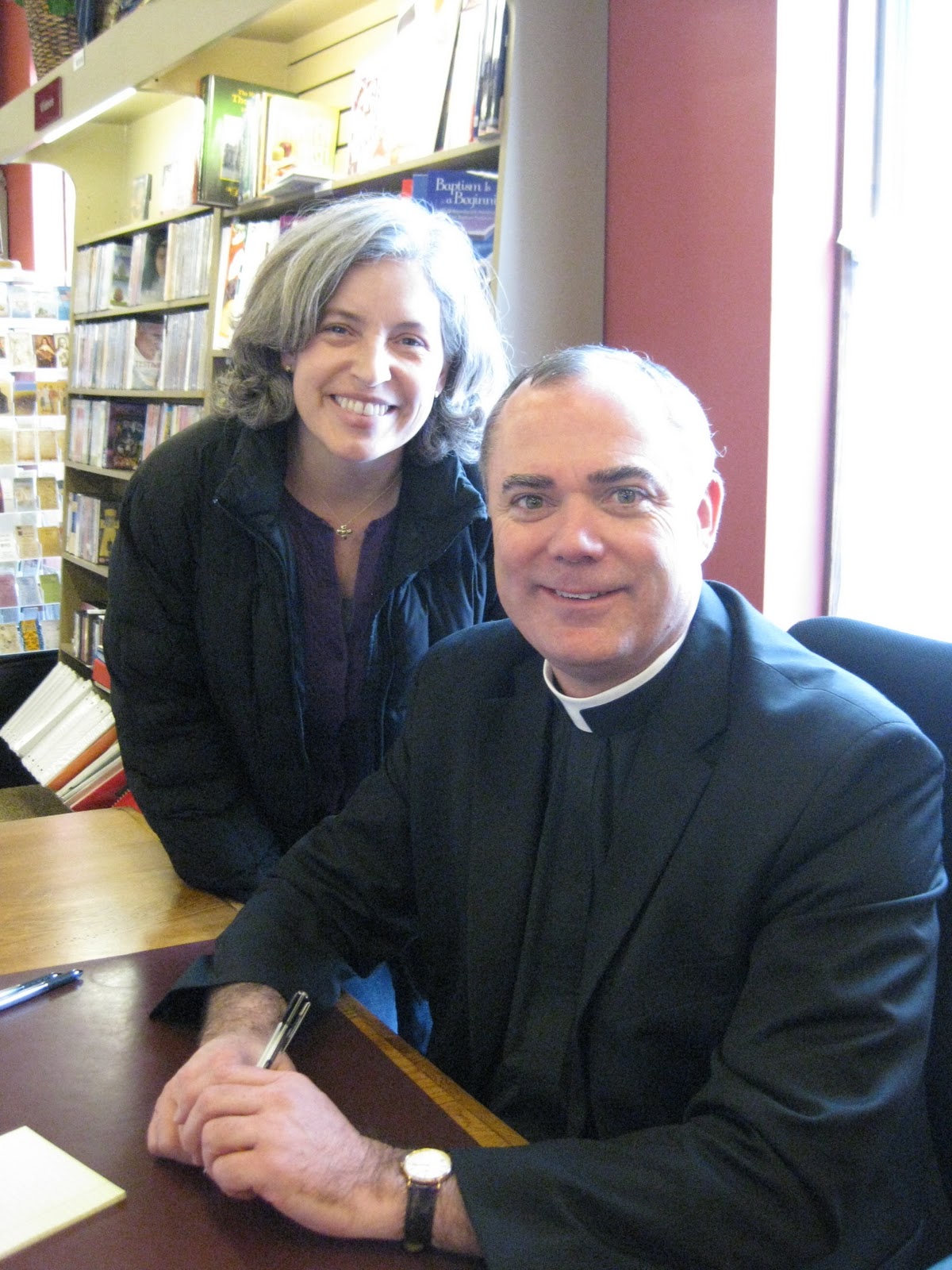
I was delighted to get to a chance to see again my old “boss” Father Gary Caster.  We spoke briefly when he did a book signing at Lagron-Miller in January, and then we were able to chat more recently about his new book, one of my Lenten recommendations, over e-mail.
Q.  Your book The Little Way of Lent is Lent from the perspective of St. Therese of Lisieux .  How did you get the idea for approaching Lent through St. Therese’ spirituality?
The idea of approaching Lent from the perspective of St. Therese came from my own personal experience and at the request of the Pastor of St. Francis Xavier in Birmingham, AL. We went to seminary together so he knew of my devotion to the Little Flower. He invited me, two years ago, to lead a Lenten Mission for the people of his parish and when I shared with him what I had in mind, he asked if I could do so but from the perspective of the Little Way of Spiritual childhood. I, of course, said yes. I welcome any opportunity to extol the genius of the Little Flower. I should also add that perhaps the most ardent supporter of this project was Msgr. Rohlfs, who has been encouraging me for years to write reflections on the Scriptures from the perspective of St. Therese.
Q.  Who is your intended audience for The Little Way of Lent? 
The intended audience of both of my books is Catholics and non-Catholics alike, between the ages of 16 and 100 and beyond. It’s my hope that what I long to share is as accessible to as many people as possible. If not, why write at all?
Q. Talk about how you came to know and love St. Therese of Lisieux.  Has she always influenced your spirituality?
I was introduced to St. Therese in the fourth grade by my teacher, Sr. Teresita. The reason she first gave me materials on the Little Flower was because of my certainty that I was called to be a priest. Since the Little Flower also knew at a young age that God was calling her to Carmel, Sr. Teresita felt that the Little Flower and me would be a perfect match.
And so it seemed at first. However, when I learned that she died young from a painful case of tuberculosis, I wasn’t so certain I wanted to be friends with her. I thought, “Great, I’m going to catch some horrible disease and die young.” Fortunately I didn’t give in to my fear and continued learning about her life.
 I think I have read just about everything, in many different languages, about her. I even wrote my master’s thesis in Church History on her.  Still, I return every year to her spiritual autobiography. I can’t begin to count the number of times I have read it. Her approach to God and her conviction of being loved by Him resonated with what I most wanted to believe as a child, as a young adult and it still resonates with what I know to be true. The confidence with which she embraced her life is, in my mind, the single greatest example of what it means to live in the freedom of being a child of God.
She wasn’t maudlin, she didn’t believe she had to prove herself to God or earn his love, and best of all, she wasn’t self-centered in the way that too often happens when people try and “make themselves’ a saint. She left everything up to God and simply tried to make every facet of her life an expression of her love for Him.
Q.  You are a college chaplain.  How do you see young people living a faith-filled life, especially one as seemingly simple as St. Therese, in today’s Internet/fast-paced culture?
I think the first problem young people have is that the spiritual life is misrepresented. Many young people do not embark on a life in the Spirit because someone –erroneously, has convinced them that it is difficult to maintain a spiritual life. They don’t abandon God because of lack of interest, they abandon God because they have been convinced that living in relationship with God is incompatible with their lives. IT ISN’T.
Once someone presents to them that because we have been made for God living in relationship with Him is easy and possible, then they readily respond. Anyone that approaches a young person with an rigorously involved program, or worse, with a proposal that the only way to really be in relationship with God is to impose some sort semi-monastic rule, should be put in time out! They are WRONG, not just where young people are concerned, but where all non-monastic people are concerned.
The internet doesn’t have to be an obstacle to a substantial life of prayer, nor does culture have to be an obstacle. We live the time in which we were born and we consecrate the unique moment of history that is ours by the way in which we incarnate the same truth that has set us free, a truth described by our current Holy Father, Benedict XVI in these words, “God says, “I believe in you!” By far the easiest way to get young people to live their lives as prayer is to bring them to the One who says the words we all want to hear, “I love you and you matter to me!”
Q.  If people are inspired by your book to learn more about St. Therese, what other books would you recommend?
People wanting to learn more about St. Therese of Lisieux should first and foremost read her own words about her life and her relationship with Jesus Christ: “The Story of a Soul: The Autobiography of St. Therese of Lisieux.” The current edition by John Clarke, OCD is the best, unless of course one reads French.
Q.  The Little Way of Lent  is your second book (Mary, In Her Own Words was published in 2006).  What writing or new books do you have planned next?
I am currently waiting to see if Servant Books will be publishing The Little Way of Advent this year. I am writing a book on St. Joseph, my mother’s favorite saint, because I believe that although there are no recorded words of his in the Scriptures, what has been preserved in Scripture about him and handed down to us by the Church is eminently rich.
 I am also writing a novel about Heaven since it is my contention that far too many Christians want to live bound by time and space as long as possible and thus do not consider the destiny that is ours, one which should be shaping every aspect of our brief sojourn in this, a foreign land. It is told by a man who opens his eyes and shares the experience of recognizing his new condition of being as communion with God and freedom from all physical, emotional limitations becomes clear. Perhaps it is only of interest to me, but it is certainly fun writing.

Share this:

  • Share on Pinterest (Opens in new window) Pinterest
  • Share on X (Opens in new window) X
  • Share on LinkedIn (Opens in new window) LinkedIn
  • Share on Facebook (Opens in new window) Facebook
  • Email a link to a friend (Opens in new window) Email
  • More
  • Share on Reddit (Opens in new window) Reddit
  • Share on Tumblr (Opens in new window) Tumblr

Like this:

Like Loading…
  • « Go to Previous Page
  • Page 1
  • Interim pages omitted …
  • Page 7
  • Page 8
  • Page 9
  • Page 10
  • Page 11
  • Interim pages omitted …
  • Page 28
  • Go to Next Page »

Copyright © 2026 · Atmosphere Pro on Genesis Framework · WordPress · Log in

  • Home
  • About
  • A Literary Pilgrimage
  • Book Group
%d